
 ChatGPT
 Perplexity

Have a game prototype or a well-defined idea and thinking how to proceed with it? Learn about pitching games in this article.
Highlights:
- Pitching your game to investors and publishers is still among the surest ways to obtain resources necessary for success;
- Game pitching requirements have gone up significantly, due to market competition;
- However, options for where and when to pitch your game have also expanded in recent years.
With the growing popularity of crowdfunding, early access programs, and self-publishing platforms, one might assume that pitching games to publishers would be less important in 2025. But that’s not quite true. Despite all these alternatives, traditional pitching remains a critical step for many indie developers seeking publisher support, funding, or strategic partnerships.
In this article, we’ll explore what has changed in the landscape of game pitching by 2025, what publishers are now looking for, and how you can craft an effective pitch deck to stand out. We’ll also cover current trends and common pitfalls, as well as touch upon possible venues to present your game.
Whether you’re a studio founder or a producer, we hope this guide will equip you with the insights needed to navigate the modern PC, console, and mobile game publishing process confidently. And if you’re on the lookout for help in pitching, Mind Studios Games offers consulting services, among others. Reach out to us via contact form, or book directly with our Head of Gamedev Ivan Dyshuk.
What has changed in game pitching by 2025
Through our work with game development teams, we've watched the pitching landscape transform dramatically. A solid pitch used to be about showing your creative vision. Now? Publishers want proof that vision can actually succeed in today's brutal market.
We've seen this shift firsthand—teams with genuinely innovative concepts getting rejected not because their games weren't good enough, but because they couldn't demonstrate market viability. The industry has become more business-focused, and pitching strategies need to match that reality.
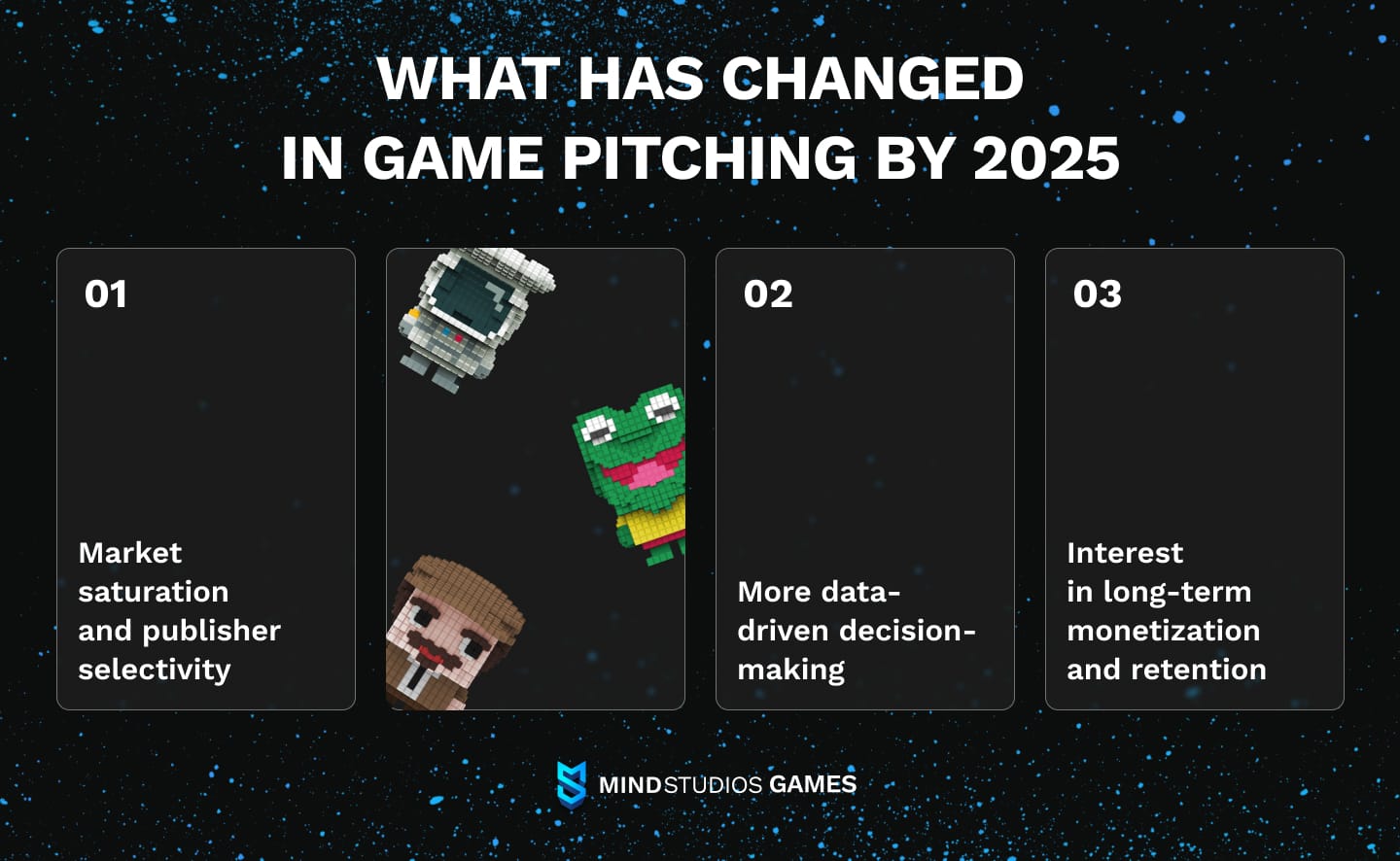
From our experience working with developers over the years, three major changes have reshaped how publishers evaluate games:
Market saturation and publisher selectivity
The number of games vying for attention has exploded in the last ten or so years. With indie developers, startups, and even established studios releasing titles regularly, publishers are more selective than ever. Pitching games to publishers in 2025 requires not just a good game, but a clear understanding of how your project fits into the current market landscape.
More data-driven decision-making
Publishers always relied heavily on analytics and real-world data, it’s a staple in the business. From wishlist counts, community engagement metrics, and early user feedback to retention rates, data points help publishers assess a game’s potential early on.
Demonstrating a solid grasp of your target audience and early traction can significantly strengthen your pitch.
This is the main reason why we don’t recommend pitching at the beginning of development — your chances will be higher when you’ve built, tested, and obtained data from your game prototype.
Interest in long-term monetization and retention
This one is not exactly new, but its importance has grown leaps with the market saturation in the background. Beyond initial sales, publishers want to understand a game’s long-term monetization strategy. This is especially true for live services, mobile titles, and games with ongoing content plans. Retention metrics, engagement loops, and monetization models are scrutinized closely.
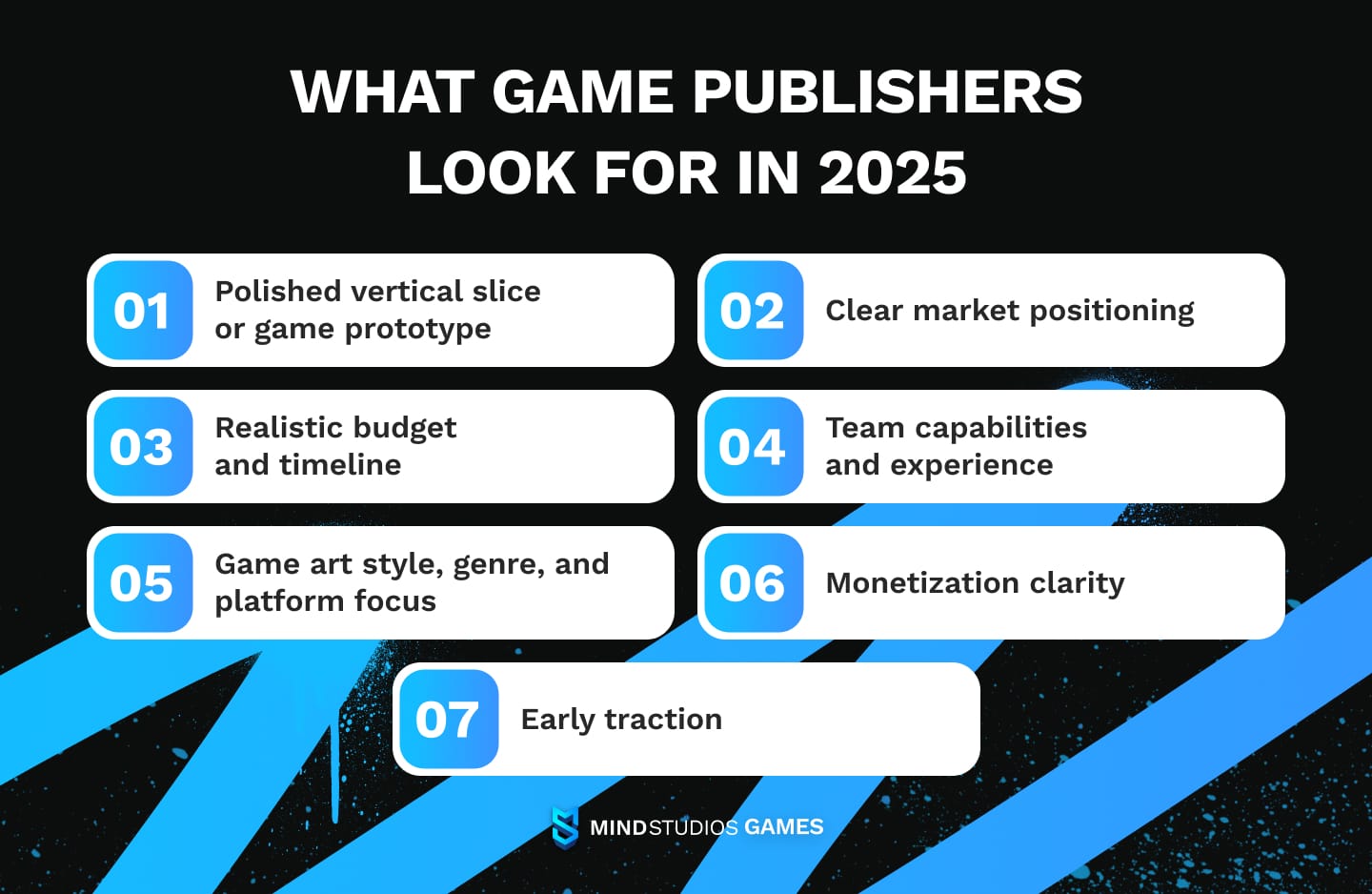
What game publishers look for in 2025
After working with dozens of game teams over the years, we've seen what separates successful pitches from the ones that never get a callback. Publishers aren't just evaluating your game—they're evaluating whether you understand the business side of gaming.
Polished vertical slice or game prototype
A playable vertical slice game or prototype remains one of the most critical aspects of your pitch.
We've watched brilliant concepts die in pitch meetings because the demo was broken, confusing, or felt like a rough prototype. Publishers don't have patience for "this will work better when it's finished" explanations.
Here's what we've learned from our successful client pitches: your vertical slice needs to nail three things in the first 30 seconds — clear gameplay, solid technical performance, and a visual style that matches your final vision.
Publishers want to see evidence that your team can deliver on your vision, so having a polished demo — rather than an early prototype or a game MVP — is essential.
This doesn’t mean your entire game needs to be complete, but the core experience should be engaging, bug-free, and representative of the final product’s quality.
Including a vertical slice helps publishers assess gameplay feel, art direction, and technical feasibility — to reduce the publishers’ perceived risk.
A well-crafted vertical slice game can demonstrate your game’s visual identity, how the mechanics work together, and whether the game can sustain player interest.
— Ivan Dyshuk, Head of Gamedev at Mind Studios
Clear market positioning
We've seen too many teams pitch with "gamers will love this" as their target market. That's not positioning — that's wishful thinking. Publishers seek projects that clearly understand their place in the market. Your pitch should articulate who your target audience is, what makes your game unique, and how it compares to existing titles. This involves thorough game market research.
Your pitch should articulate:
- Who your target audience is
- What makes your game unique
- How it compares to existing titles
- Your competitors and the gaps your game fills
- Your game's value proposition
When we work with clients on their pitch strategy, we make them get specific about who will actually pay for their game. One team told us their narrative RPG was "for RPG fans." After digging deeper, we discovered their game was actually perfect for players who loved Disco Elysium's dialogue system but wanted more traditional combat. That specific positioning got publishers interested because they could immediately see the market gap.
Realistic budget and timeline
Publishers are risk-averse and prefer projects with achievable goals. Overly optimistic timelines or inflated budgets can raise red flags, making publishers wary of overpromising and underdelivering. For example, we've had clients come to us claiming they could build their dream JRPG in 8 months with a team of 4 people. That's not confidence — that's a red flag.
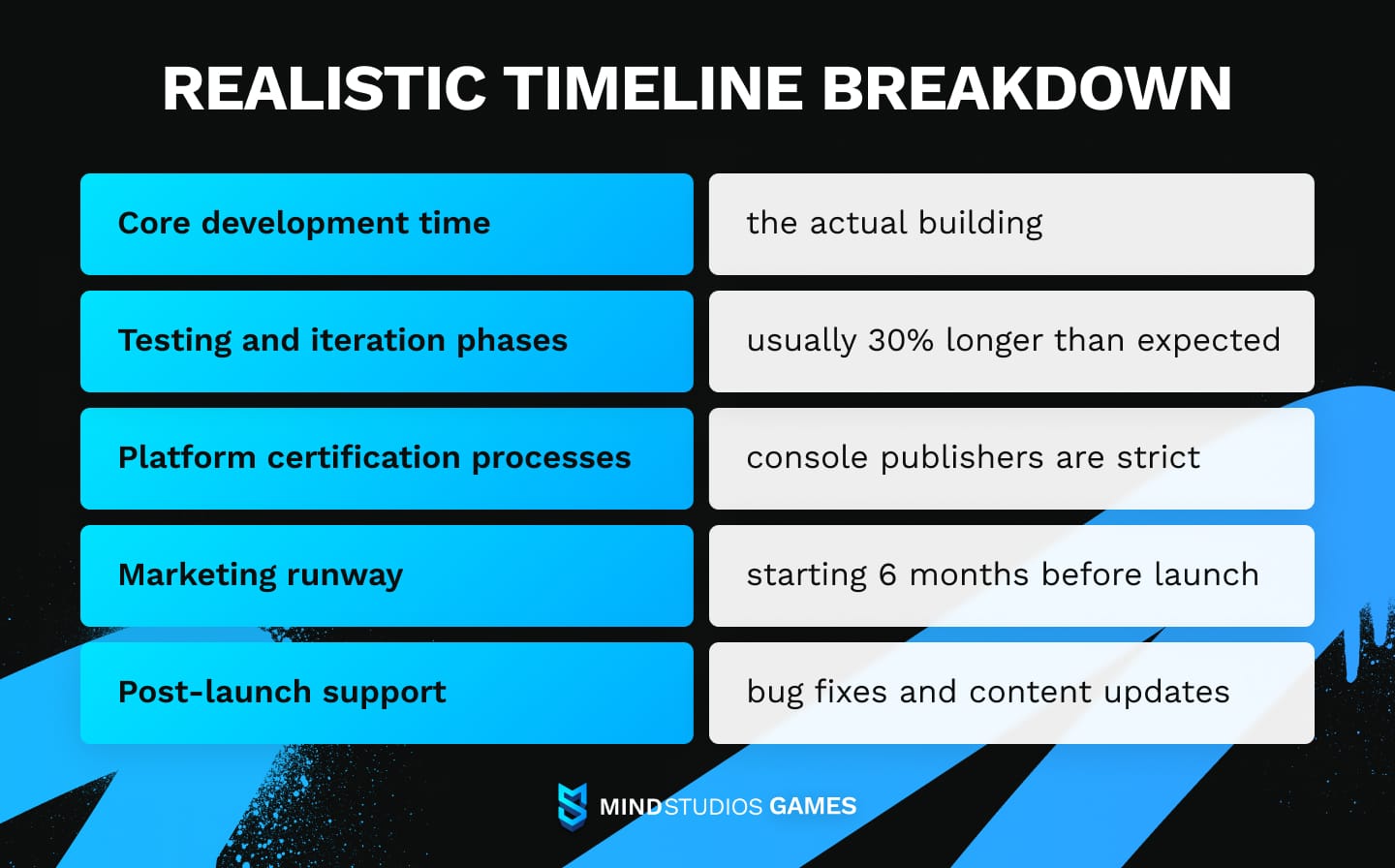
Through our projects, we've learned to break down every aspect of development:
- Core development time (the actual building)
- Testing and iteration phases (usually 30% longer than expected)
- Platform certification processes (console publishers are strict)
- Marketing runway (starting 6 months before launch)
- Post-launch support (bug fixes and content updates)
Providing a rationale for your estimates helps build trust and demonstrates professionalism. For example, if you’re requesting funding for a 12-month development cycle, outline exactly what will be accomplished each month, including playable builds, testing phases, and marketing efforts.
Team capabilities and experience
A strong, capable team is among a publisher’s top considerations. Whether you have in-house developers or you’re entrusting tasks to an outsourced service, it’s best to highlight relevant experience, past successes, and specific skills that ensure your project’s success.
Highlight these areas:
- Game design expertise
- Technical proficiency
- Art and animation capabilities
- Successful releases on similar platforms
- Ability to overcome technical challenges
- Track record of meeting deadlines
- Adaptability to unforeseen issues
Publishers want confidence that your team can overcome technical challenges, meet deadlines, and adapt to unforeseen issues. Demonstrating a cohesive, experienced team reassures publishers that their investment will be managed effectively.
Game art style, genre, and platform focus
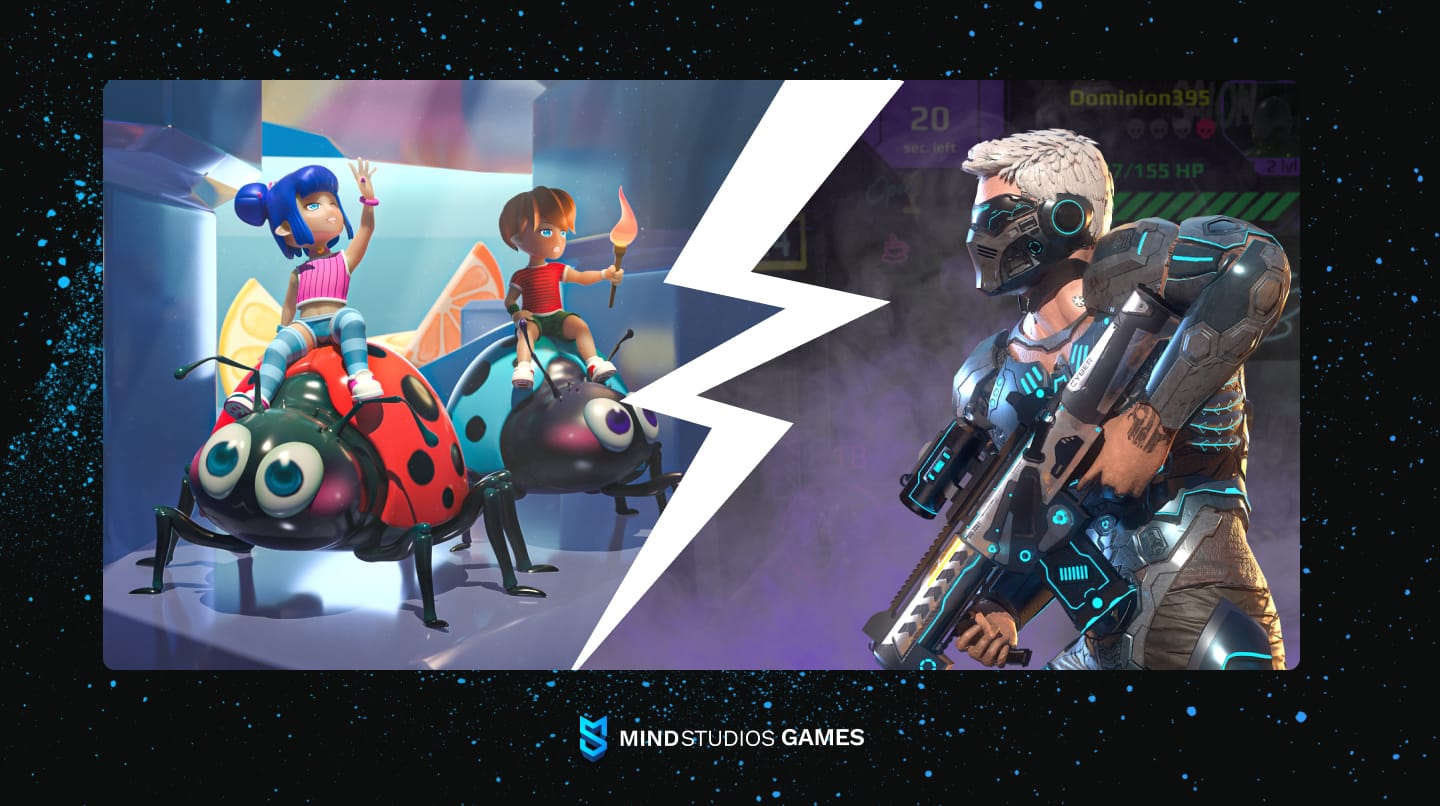
Alignment with publishers’ existing portfolios or strategic interests is essential. If your game’s art style and genre match those of a particular publisher, your pitch has a better chance. A stylized, family-friendly platformer might appeal to publishers with a history of successful casual or mobile titles, but a gritty, realistic shooter aligns with different segments.
Plus, be explicit about your target platforms — PC, consoles, mobile — and how your game leverages each platform’s strengths. Clearly articulating these things shows you understand your market.
Monetization clarity
For projects that involve ongoing revenue streams, such as live-service games, mobile titles, or MMOs, publishers demand a detailed monetization plan.
Publishers want to see:
- How you intend to generate income:
- How these strategies will sustain the game long-term
- How monetization aligns with player experience
- How you avoid predatory practices
- How it fits the genre's expectations
Explain how your monetization aligns with player experience, avoids predatory practices, and fits the genre’s expectations.
❗️Note: Providing data on expected ARPDAU (average revenue per daily active user) or retention curves can further strengthen your case.
Early traction
Evidence of early market interest can significantly sway publisher decisions.
Metrics such as wishlist counts on Steam or app stores, social media followers, community engagement, press coverage, or positive beta feedback all signal market validation. These indicators reduce risks and suggest that players are already interested in your game.
If you have a dedicated community or received coverage from popular gaming media, include this data in your pitch to demonstrate momentum. Early traction shows that your game has the potential to succeed upon release, making it a more attractive investment.
Essential components of a game pitch deck
A compelling pitch deck communicates your vision clearly and professionally. Here are the core elements you simply must include in one:
| Pitch deck element | Brief description |
|---|---|
| Short game overview | A concise elevator pitch summarizing your game’s core concept and appeal. |
| Expanded overview | Identify the genre, platforms (PC, console, mobile), and visual or gameplay inspirations to contextualize your project. |
| Core gameplay loop | Describe what players will do, why it’s engaging, and what makes your game fun and unique. |
| Visuals | Include concept art, mood boards, or gameplay screenshots to convey game art style and tone. |
| Market research | Demonstrate understanding of your target audience, key competitors, and industry trends. |
| Timeline | Outline development milestones, alpha/beta phases, and estimated release date. |
| Budget | High-level cost estimates, funding needs, and how the publisher’s support will be used. |
| Team | Introduce key team members, their backgrounds, and relevant experience. |
| Monetization | Explain how your game will generate revenue and sustain itself post-launch. |
Optional but impressive extras
Adding extra materials can set your pitch apart:
- Playable demo or build access. Let publishers experience your game firsthand. (Honestly, we would actually recommend including this one in must-have’s)
- Playtest feedback and retention data. Support your claims with user data.
- Publisher-specific customization. Tailor the deck to match each publisher’s portfolio or preferences.
- Post-launch roadmap. Show plans for updates, expansions, or live services.
- Press kit and trailer. Professionally produced trailers and media assets add polish.
5 common mistakes to avoid
Now to the less fun but nonetheless essential part — mistakes new game owners (and some seasoned ones) make. After all, avoiding common pitfalls can be the difference between a successful pitch and a missed opportunity.
Here are some key mistakes to watch out for, along with explanations of why they undermine your chances.
#1 Overpromising timelines
The mistake
Developers consistently underestimate how long games take to build. We've worked with teams claiming they can build complex RPGs in 6–8 months or finish multiplayer systems in just a few weeks. The enthusiasm is admirable, but the math isn't mathing.
Why it backfires
Publishers have funded hundreds of games and know the real timelines. When even experienced studios like Team Cherry spend years on their games (it took them 7 years to finish Hollow Knight: Silksong!), claiming you'll build something similar in 8 months makes you look naive at best, and a liar at worst.
What to do instead:
- Build in 20–30% buffer periods for each milestone
- Provide clear rationale for your timeline estimates
- Show phased development with realistic checkpoints
- Demonstrate you understand potential risks and delays
#2 Ignoring business model clarity
The mistake
“We'll figure out monetization later” or “we're just focused on making a great game first.” This approach kills publisher interest faster than any technical issue ever could.
Why it backfires
Publishers aren't funding passion projects — they need a clear path to profitability. We've seen teams with brilliant concepts get rejected because they couldn't explain how players would actually bring revenue to their game.
What to do instead:
- Detail your specific revenue streams (premium, F2P, subscriptions, DLC)
- Show how monetization fits your target audience's expectations
- Provide pricing strategies and post-launch support plans
- Include projected revenue data if available
#3 Lacking a playable build or visual game prototype
The mistake
Tangible evidence can often make or break a pitch. A pitch deck alone is no longer sufficient in many cases. Publishers increasingly expect to experience a playable demo, vertical slice game, or at least a set of gameplay screenshots or videos to evaluate your game’s quality and potential.
Why it backfires
Without a playable build, your project may seem too abstract or untested, raising doubts about your ability to deliver.
What to do instead:
- Build a polished vertical slice that showcases core mechanics
- Create compelling gameplay videos if a demo isn't ready
- Include high-quality screenshots that demonstrate visual quality and style
- Show progression from concept to working prototype
#4 Pitching too early without a focused game loop
The mistake
Timing is critical. Pitching your game too early, before your core gameplay loop is refined, can lead to unfavorable impressions.
Why it backfires
A vague concept or a game still in ideation stages signals to publishers that your team may not be ready to execute.
What to do instead:
- Develop a clear, engaging core loop before pitching
- Test and iterate your mechanics with real players
- Ensure your game's unique value is clearly demonstrated
- Wait until you can confidently explain what makes your game fun
#5 Sending a generic deck to all publishers
The mistake
Essentially, a pitch deck is your cover letter, like the one you’re attaching to your CV when applying for a job.
Why it backfires
Sending the same deck to multiple publishers without tailoring it to each one’s portfolio, interests, or strategic focus shows a lack of effort.
What to do instead:
- Research each publisher's existing catalog and recent signings
- Customize your deck to highlight alignment with their interests
- Reference specific games in their portfolio that relate to yours
- Show understanding of their strategic focus and target markets
- Tailor your monetization discussion to their business model preferences
Where and how to pitch your game in 2025
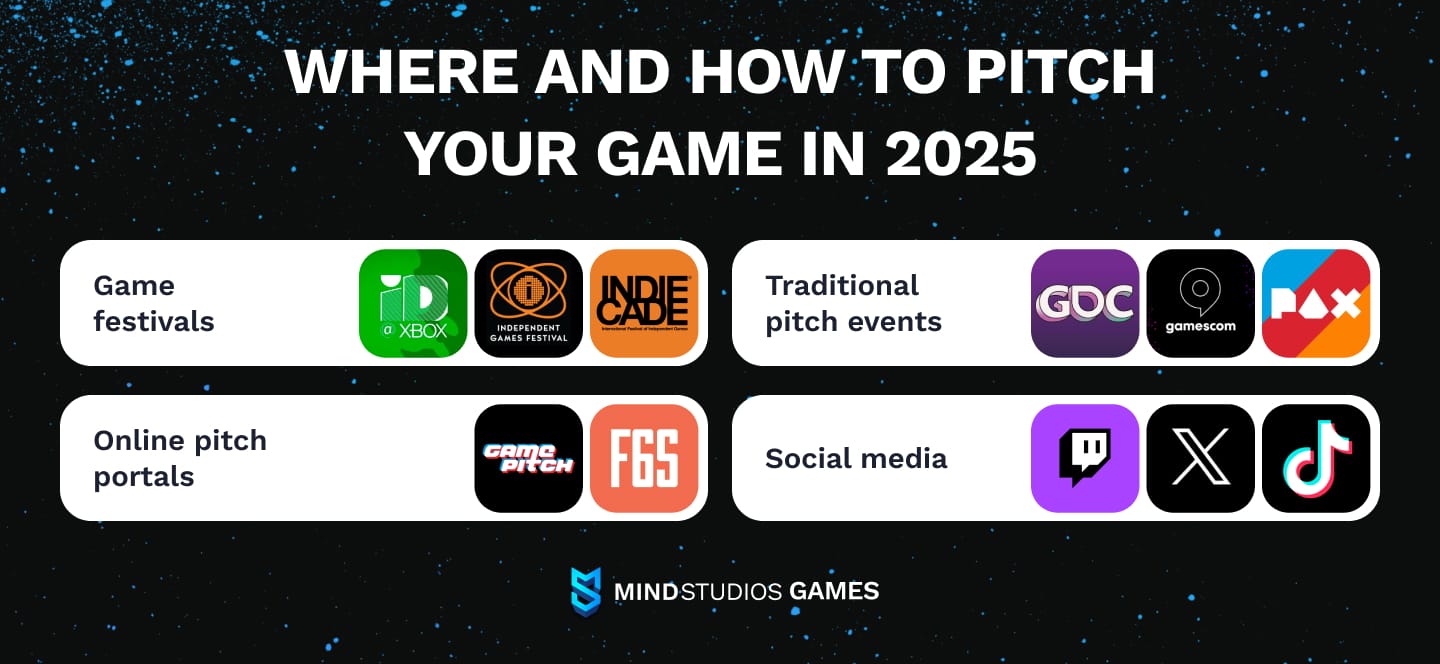
Knowing the right venues and approaches to pitch your game is crucial in the increasingly crowded market. The gaming landscape offers a mix of traditional and innovative channels, each with its own advantages.
Game festivals and competitions
Platforms like the Independent Games Festival (IGF), IndieCade, and the ID@Xbox are excellent for gaining recognition. These festivals often have dedicated pitch sessions or awards that can boost your credibility. They also attract publishers scouting for innovative indie titles, especially if your game offers a unique concept or fresh mechanics.
Online pitch portals and virtual conferences
Digital platforms have become vital for connecting developers with publishers. Websites like GamePitch, F6S, or industry-specific matchmaking services organize virtual pitch meetings, where game owners can upload their pitch deck, demo, and project info. The platforms then connect interested publishers or investors in scheduled video calls.
Additionally, with technological advancements and the ongoing shift towards remote interactions, many publishers now host online pitch sessions, webinars, and Q&A panels. Participating in these events can give you direct access to decision-makers from the comfort of your home or office.
❗️Note: Do ensure your pitch materials are optimized for digital presentation — short, engaging videos, clear visuals, and concise summaries work best.
Traditional pitch events
Major industry conferences and events like GDC (Game Developers Conference), PAX, Gamescom continue to be premier venues for networking and pitching games. These conferences often host pitch sessions, showcases, and developer booths where you can meet publishers, investors, and media.
Many of these events also provide pitch competitions, where you can participate to gain visibility and feedback.
❗️Note: Preparing a compelling pitch presentation, demo, or trailer beforehand is essential.
Leveraging industry connections and mentors
Tap into your professional network: attend local meetups, industry mixers, or online forums like Discord communities and LinkedIn groups.
Building genuine relationships can lead to warm introductions, increasing your chances of getting a meeting or consideration. Mentors and fellow developers can also provide valuable feedback, refine your pitch, and recommend you to publishers.
Social media and community platforms
Showcase! Twitch, X, Bluesky, TikTok, Instagram, YouTube are all there for your perusal. Publishers and investors often monitor social media for promising projects. Sharing engaging gameplay clips, behind-the-scenes content, or developer diaries can attract attention. Tag relevant industry accounts or publishers to increase visibility.
Also, platforms like Itch.io, Steam Community, and Discord servers host game jams, showcase events, and have developer chats. Presenting your game there can generate community interest and feedback, demonstrating market validation that publishers value.
Conclusion
In 2025, pitching games to publishers remains a vital step toward securing support and taking your project to the next level. Success hinges on clarity, polish, and a deep understanding of what publishers seek: a compelling, market-ready product backed by a capable team and clear business strategy.
Prioritize developing a strong, data-informed pitch deck, avoid common pitfalls, and tailor your approach to each publisher’s interests. Remember, the goal is to communicate your vision effectively, demonstrate your team’s capability, and build confidence in your project’s potential.
If you need help sharpening your pitch or developing a professional pitch deck, don’t hesitate to reach out to us. With almost ten years on the gaming market developing our own games as well as working with external clients, Mind Studios Games has unique insights into what a pitch can be, and how to make it better. Schedule a consultation and we’ll get back to you.