
 ChatGPT
 Perplexity

Discover how to design mobile games for Gen Alpha — covering UX, game mechanics, monetization, and safety-first design from Mind Studios Games experts.
- Gen Alpha doesn’t know what it is like, to grow up without digital services
- They value individuality and high levels of customization more than any generation before them
Generation Alpha — or Gen Alpha — roughly refers to children born from 2010 onward, the first generation fully born in the 21st century. They are also the first fully digital-native generation, growing up surrounded by smartphones, tablets, and instant access to content. For them, touchscreens are intuitive, voice commands are natural, and digital interaction is part of everyday life.
As the oldest Gen Alpha members become teens, they are beginning to shape the next major wave of mobile gaming trends that will follow them into the next decade or two, at least. Their preferences — visual engagement, interactivity, and creativity — are already influencing how we approach game development, storytelling, and design.
In this article, we’ll explore what makes mobile games for Gen Alpha unique, what design and UX principles resonate with them, and how studios can build games that are both fun and responsible for this new audience. We’ll offer insights from research and our development experience, as well as some personal takes — after all, many of today’s seasoned developers are the ones with Gen Alpha kids 😁
And who can be better at creating games for our youngest generation than their parents, who have exclusive data on their gaming habits and behaviors? So if you’re looking for a team to develop or co-develop your Gen Alpha game, or a specific professional with both experience and invested interest, contact Mind Studios Games or our Head of Gamedev directly.
Understanding Gen Alpha: Key behaviors and tech habits
To start off, here are the top 5 characteristics of Gen Alpha:
- Mobile-native from birth
- Have digital-savvy parents
- Consumers of fast content
- Have short attention spans
- Big proponents of creativity and customization
Sounds fairly simple, right? How does this influence their gaming behavior, though?
Mobile-native from birth: Comfort with touch, voice, and instant feedback
Gen Alpha has grown up with smartphones in hand — literally. According to a 2024 Pew Research study, 95% of U.S. teens own or have access to a smartphone.
Children of Generation Alpha are the first to grow up fully immersed in mobile and touch-driven devices. Studies show that in certain markets, around 94% of Gen Alpha own a smartphone by age 11. Another data from 2024 indicate that 80% of children aged 11 and under use a tablet at least once per month. For many of these children, interacting via taps, swipes, voice commands or gestures is second nature, not a novelty. Thus, when it comes to mobile experiences, their expectation of quick responses is considerably higher than previous generations.
What it means for game developers:
Modern games aimed at the youngest generation must deliver ultra-smooth interactions, minimal lag, and feedback that feels natural and intuitive. Delays, complex menus, or long load times can be especially off-putting for this generation.
Digitally savvy parents: Heavy involvement and digital gatekeeping
Children in Gen Alpha are playing games in a context where their parents — mostly Millennials — are fully digitally literate and involved, but that’s not all. Gaming is increasingly a shared activity between children and parents!
If the parents are uncomfortable with the game experience, they will intervene. Hence, game studios aiming at Gen Alpha must respect this dimension and design not just for the children, but for the family context in which they play.
What it means for game developers:
From a development standpoint, this results in the need to pay more attention to:
- parental controls,
- transparent monetization,
- data privacy safeguards, and
- safe-social features.
Preference for fast, intuitive, visual content
Gen Alpha grew up with full exposure to TikTok and Instagram stories/reels — they’re used to short bursts of content and highly visual interfaces. Approximately 65% of children aged 8–10 spend up to four hours a day on social media and other screen-based activities. The dominance of platforms like YouTube highlights the scale of visual and on-demand consumption.
What it means for game developers:
When developing games for Gen Alpha, visual clarity, bold iconography and immediate gratification matter a lot. Extended exposition, dense text menus, or slow-to-respond mechanics can and will disrupt their engagement. Building rich gameplay while respecting Gen Alpha’s appetite for fast, clear, and instantly rewarding experiences is a challenge modern game developers can’t overlook.
Short attention spans and multitasking behavior
Because Gen Alpha grew up as digital natives, they often switch between activities — gaming, chatting, streaming — without much friction. According to recent research, nearly half of young children engage in other digital activities (such as watching videos) while gaming.
That means mobile titles need to accommodate partial attention rather than full focus.
What it means for game developers:
For game developers this means designing session lengths and mechanics accordingly: short loops, clear reward signals, easily paused/resumed gameplay, and interfaces that don’t assume undivided attention. Games that are too long or too deep without visible reward may lose this generation’s interest quickly.
High expectations for creativity, customization, and agency
Gen Alpha players expect more than passive experiences — they look for options to express themselves, customize their environment, and influence outcomes. Owning devices early and using assistive tech like Alexa or Siri underlines their comfort with interactive systems. These kids are not just consumers but potential creators, and they start young.
What it means for game developers:
In practical game design terms, this translates to sandbox mechanics, avatar customization, world-building elements, and social sharing features. If your game restricts young players to rigid paths without freedom or self-expression, it risks being less appealing. The appeal of platforms where they can create and share their own content sets a high bar for mobile titles targeting Gen Alpha.
Game UX and design considerations for Gen Alpha
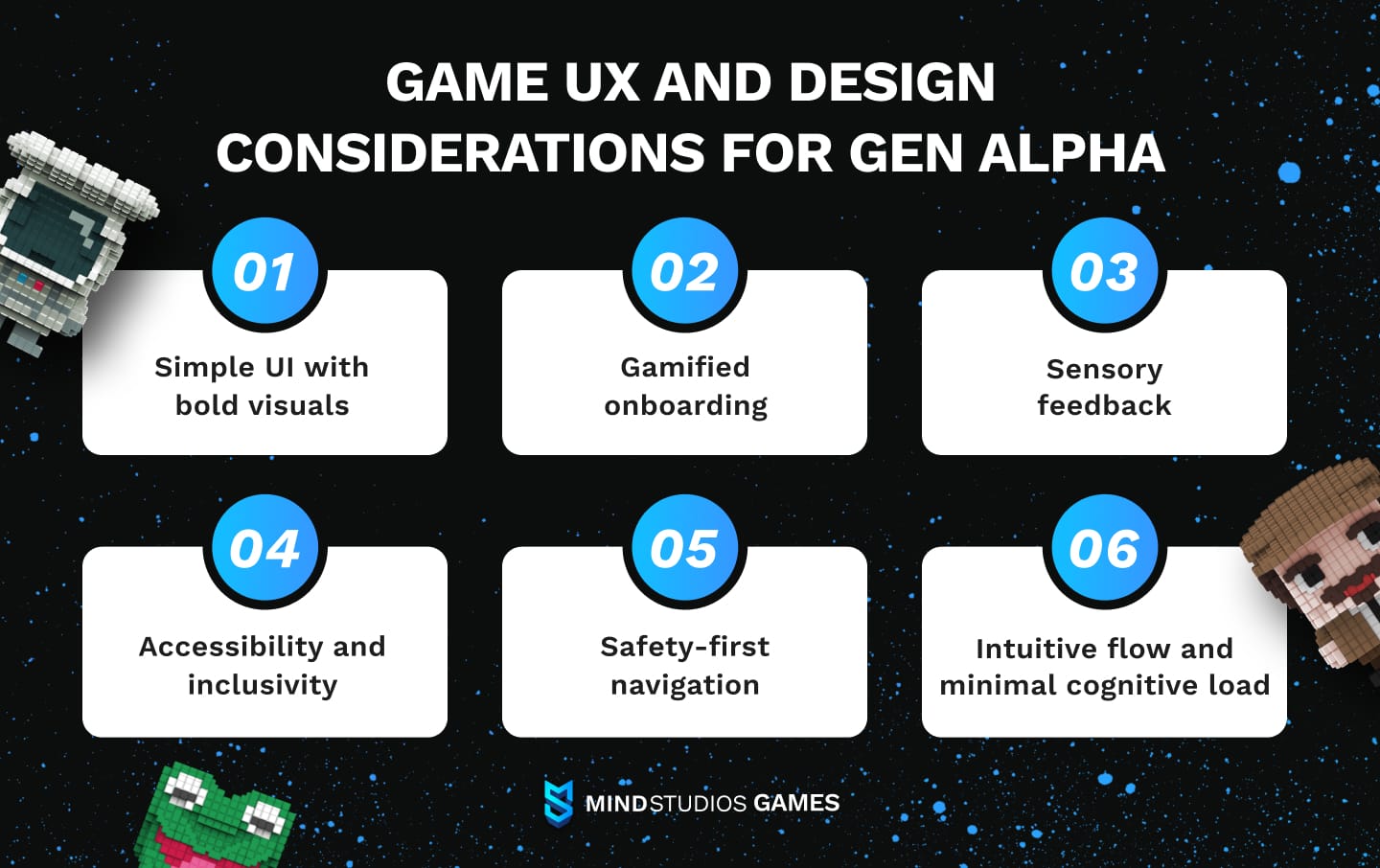
A strong UX and UI strategy defines whether players will engage or drop off, and designing for Gen Alpha means simplifying complexity. We’ve drawn up a simple table to explain the currently recommended approach when making games targeting this generation.
Focus |
Description and practical application |
|---|---|
Simple UI with bold visuals |
Gen Alpha players tend to choose clarity over complexity. They navigate primarily through icons, colors, and movement, not text-heavy menus. Clean layouts, bold contrasts, and large tap targets make interfaces feel intuitive. In practice: Use clear iconography, bright but balanced color palettes, and large interactive zones to support quick recognition. Avoid nested menus or small touchpoints, as they frustrate younger users. |
Gamified onboarding |
Traditional text-based tutorials don’t work for this age group. Instead, onboarding should feel like part of the game — fast, visual, and interactive. In practice: Teach through play: short missions, animations, character guidance. Reward early engagement with small achievements or collectibles that will transfer to the game itself. |
Sensory feedback |
Feedback loops help young players understand cause and effect, encouraging exploration and mastery, and Gen Alpha expects responsive, sensory feedback. Haptic vibrations, sound cues, and subtle animations provide instant validation and are good for any age group, but they’re must-haves for Gen Alpha. In practice: Implement micro-animations, tactile haptics, and cheerful sounds for success states. Use subtle cues (like screen flashes or vibrations) to reinforce interactions. |
Accessibility and inclusivity |
This generation values representation and flexibility more that any before them. Accessibility isn’t optional; it’s expected. They want characters, voices, and visuals that reflect diverse identities and abilities. In practice: Customizable avatars, inclusive voice and gender options come to mind first, but also don’t forget such accessibility tools as text resizing, dyslexia-friendly fonts, and colorblind modes. |
Safety-first navigation |
As already mentioned, parents expect transparency and safety by design. Games must protect user data, restrict unwanted contact, and comply with child-privacy laws. In practice: Approach COPPA/GDPR-K compliancy specialists for advice. Include safe-chat filters, content moderation, and easy parental dashboards for monitoring playtime or purchases. |
Intuitive flow and minimal cognitive load |
Remember that short attention span? Yeah. Children of Gen Alpha quickly disengage when confronted with clutter or friction. Every tap should feel predictable and reward-based. In practice: Reduce steps between intention and action: use floating buttons, progressive disclosure, and smart defaults. Show progress visually to maintain motivation. |
Mind Studios Games’ insight: When designing interfaces for young players, use the so-called “invisible guidance” or “guided freedom” — interfaces that are structured enough to prevent confusion but flexible enough for self-discovery. This kind of intuitive UI subtly directs players without breaking immersion. This includes visual anchors, consistent icons, and small animations that cue progression naturally.
We also recommend testing prototypes directly with children and parents when possible — to ensure that clarity, accessibility, and emotional engagement align with their expectations.
Game mechanics that resonate
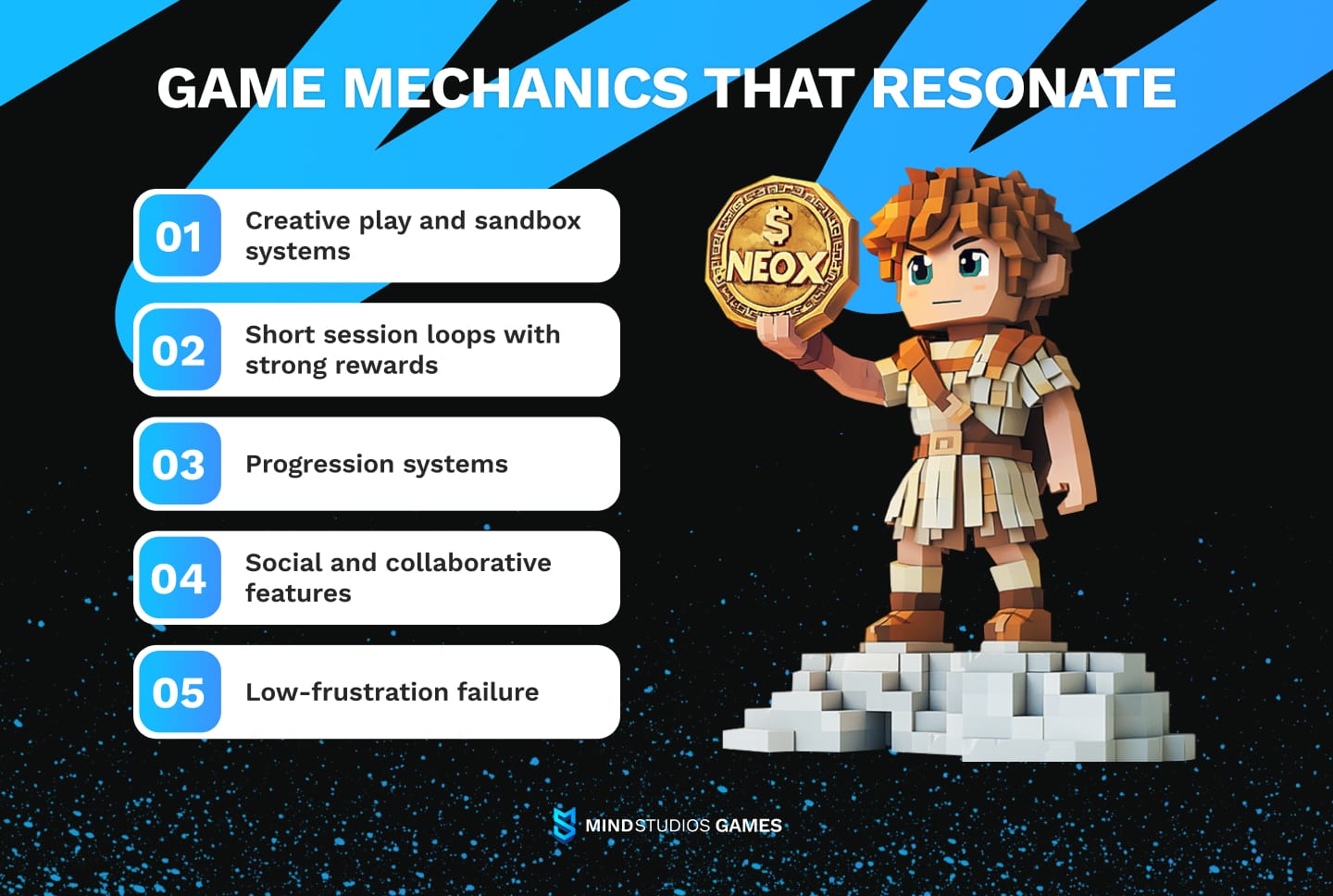
When designing for Generation Alpha, mechanics must satisfy three main needs we covered above: immediacy, creativity, and connection. This audience enjoys discovering how systems work, but only if feedback is instant and rewards are tangible. Below are the core mechanics that keep Gen Alpha players engaged — with examples from games they already love.
#1 Creative play and sandbox systems
Gen Alpha thrives on creative autonomy and open-ended play. Earlier generations were content with pre-built worlds. Today’s young players? They want to build, modify, and personalize. Games that empower them to experiment — and do it without rigid structure — stand out.
Games that do this well:
- Roblox allows players to design their own worlds and game modes using simple creation tools. This freedom to create not only boosts engagement but also fosters early problem-solving and coding curiosity.
- Minecraft, despite being a veteran game, continues to attract Gen Alpha with its open-ended sandbox where imagination drives progress. Players collaborate on building projects, share creations online, and even learn teamwork organically.
- Toca Boca World focuses on free exploration and story creation, giving kids full control over how their play unfolds.
The takeaway: creative expression is gameplay. Let players author their own experience, rather than just follow one.
#2 Short session loops with strong rewards
Attention spans among Gen Alpha players are generally shorter than any generation before them. Most play in short bursts — between classes, during car rides, or before bedtime. Hence, their games need tight, rewarding loops that provide instant gratification through rewards, collectibles, or level-ups, delivering satisfaction quickly.
Games that do this well:
- Subway Surfers and Stumble Guys, where matches last 2–3 minutes and success is visible through coins, cosmetics, and streak counters.
- Pokémon Unite, which keeps team battles under ten minutes while offering clear progression through ranked tiers and seasonal rewards.
To build similar engagement, developers should:
| 1. Design clear mini-objectives that can be completed in 1–3 minutes. |
| 2. Provide immediate feedback (visual, audio, or numerical) for every achievement. |
| 3. Use layered progression systems so that even short play sessions feel meaningful. |
#3 Progression systems
Gen Alpha responds strongly to visible achievement. Collectibles, badges, and ranking stars act as digital trophies that reward consistency and effort. The psychology behind this is simple: small, incremental wins foster a sense of competence and belonging.
Games that do this well:
- In Pokémon GO, each milestone, from capturing a new species and hatching eggs to completing research tasks, comes with vivid animations and celebratory sounds.
- Brawl Stars uses badges and trophy counts to make progress feel measurable, even over a few short matches.
- Educational titles such as Kahoot! Kids apply a similar model by rewarding correct answers with visual praise and streak bonuses.
Developers targeting Gen Alpha should visualize progress whenever possible to make growth feel tangible. Do this through animations, achievement boards, or avatar evolution.
#4 Social and collaborative features
Gen Alpha players use gaming as a social playground. According to a 2025 report from Precise TV, over 60% of children aged 8–12 regularly play games with friends online or in person — it’s one of the reasons many parents raise concerns over excessive screen time. Social mechanics, therefore, play a crucial role in retention.
On the other hand, features like team-based missions, cooperative goals, and moderated chat systems allow Gen Alpha to connect and learn teamwork.
Games that do this well:
- Roblox’s shared servers and friend lists enable safe cooperation and co-creation.
- Pokémon Unite’s team-based gameplay, where coordination and mutual support determine victory.
- Animal Crossing: Pocket Camp, which encourages visiting friends’ islands and trading items.
❗️ Word of caution from Mind Studios Games: To stay on the safe side of the parents’ (and governments’) ire, any social features in games aimed at children need to be heavily safeguarded. This means moderated chat systems and family-friendly matchmaking with age verification. Collaboration should feel rewarding but never risky, and community design must include privacy filters and content moderation from day one.
#5 Low-frustration failure
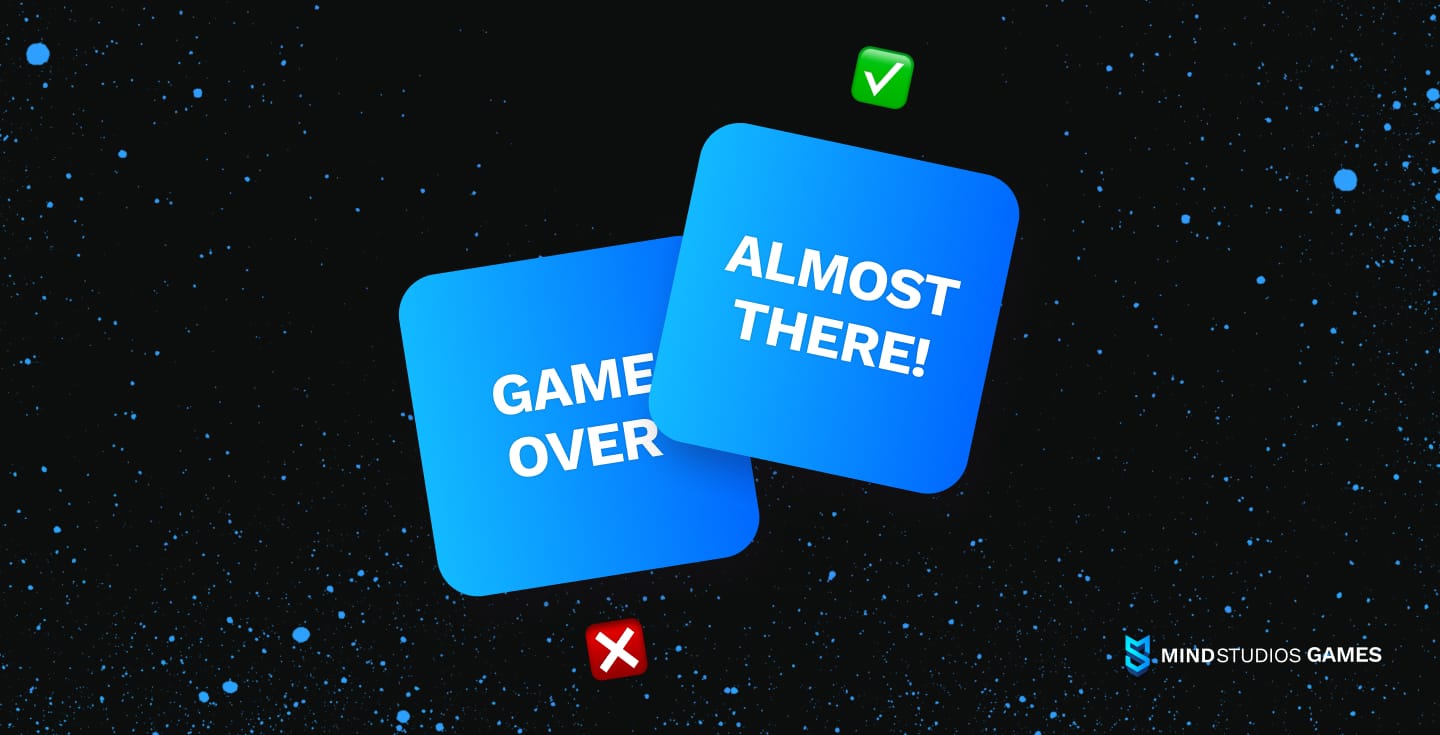
Failure can either motivate or discourage. Remember that the oldest Gen Alpha kids are only now turning 15 — a tender age when they’re still developing emotional resilience. Games that punish mistakes harshly tend to backfire with them (and also might be damaging to their mental health). They prefer systems that treat setbacks as learning opportunities rather than judgment.
So instead of “Game Over,” consider retry loops, gentle resets, or positive feedback. Encouraging resilience helps sustain engagement and supports emotional development.
Games that do this well:
- Super Mario Run uses quick restarts and cheerful sounds when players fail, turning retries into another chance to improve.
- LEGO Star Wars Battles gives bonus hints after failed missions, reinforcing that experimentation is part of play.
To reiterate, if you want to design low-frustration mechanics:
| 1. Use positive feedback loops (e.g., “Almost there!” instead of “Game Over”). |
| 2. Provide small consolation rewards for effort. |
| 3. Encourage retry behavior with instant respawns or quick restarts. |
This approach builds confidence and emotional engagement, keeping Gen Alpha players motivated to continue learning through play.
Mind Studios Games’ insight: Add “motivational failure loops” in your games — small setbacks that inspire reattempts through visual encouragement and sound design. This approach significantly boosts retention among younger users.
3 monetization models that work — and another 3 that don’t
Monetization in Gen Alpha video games must balance profitability with ethics.
The audience is too young to manage spending independently, and their parents — mostly Millennials — are digitally literate and cautious. Successful monetization, therefore, means earning parental trust while keeping gameplay fair, fun, and accessible.
Below are the models that align best with Gen Alpha’s expectations and cognitive development, followed by practices that can harm brand perception and retention.
What works
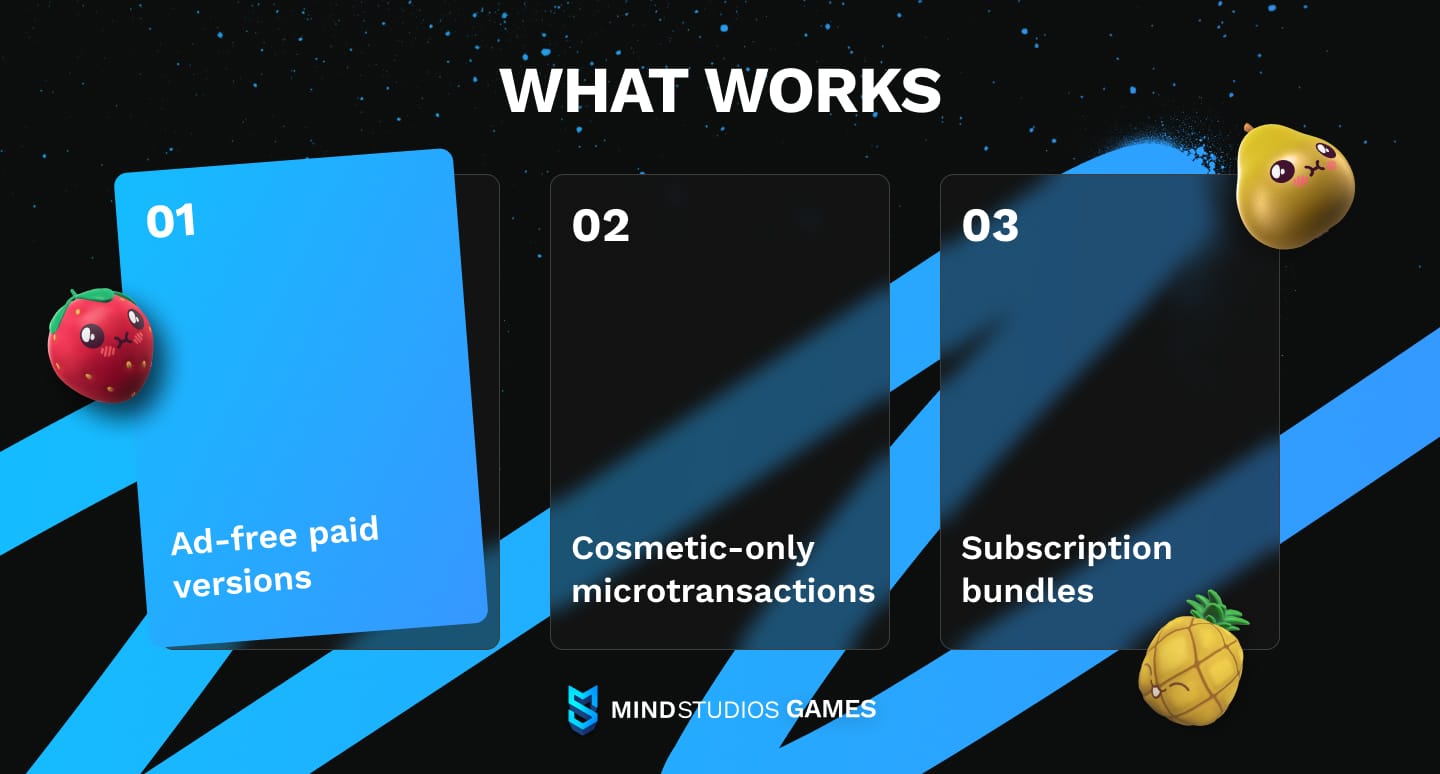
#1 Ad-free paid versions
Free-to-play games dominate mobile markets for adults, we talk about it in every other guide. However, ad-free premium editions remain a trusted choice for family-oriented games. Parents appreciate the predictability of a one-time purchase that eliminates both intrusive ads and in-app traps.
This model works particularly well for educational or creativity-focused titles. Parents see these as long-term investments rather than fleeting entertainment. The key is transparency — clearly communicating that the fee guarantees a safe, uninterrupted experience. When paired with optional expansions or DLCs released later, this approach sustains revenue without eroding trust.
#2 Cosmetic-only microtransactions
Once again — Gen Alpha values personal expression. So offering visual customization in the form of skins, outfits, emotes, and stickers gives them an outlet to stand out and personalize the play without affecting competitive balance. This mirrors their social media behavior, where identity and self-presentation play major roles.
Roblox and Brawl Stars excel at this model: cosmetic upgrades feel optional but enticing, while gameplay remains fair for non-paying players. To apply this ethically, developers should ensure that:
- Cosmetic items are never tied to power boosts.
- Prices are transparent and proportionate to the perceived value.
- Parents can easily disable or approve purchases through control dashboards.
This model encourages creativity and safe self-expression while preserving a level playing field — two values Gen Alpha and their parents care deeply about.
#3 Subscription bundles
Subscriptions have grown increasingly popular among parents seeking predictable monthly spending. Subscriptions for children’s games are growing, largely driven by content curation and ad-free environments.
It’s a win for all: for developers, subscription models provide stable recurring income; for players, they reward loyalty.
Subscriptions in games work best when subscribers receive:
- Exclusive cosmetic items or experiences, not pay-to-win perks.
- Curated educational or creative content added regularly.
- Family sharing features that encourage group participation.
When done right, subscriptions reinforce both brand trust and retention. The challenge, however, is content cadence: developers must update consistently to justify ongoing value.
What to avoid
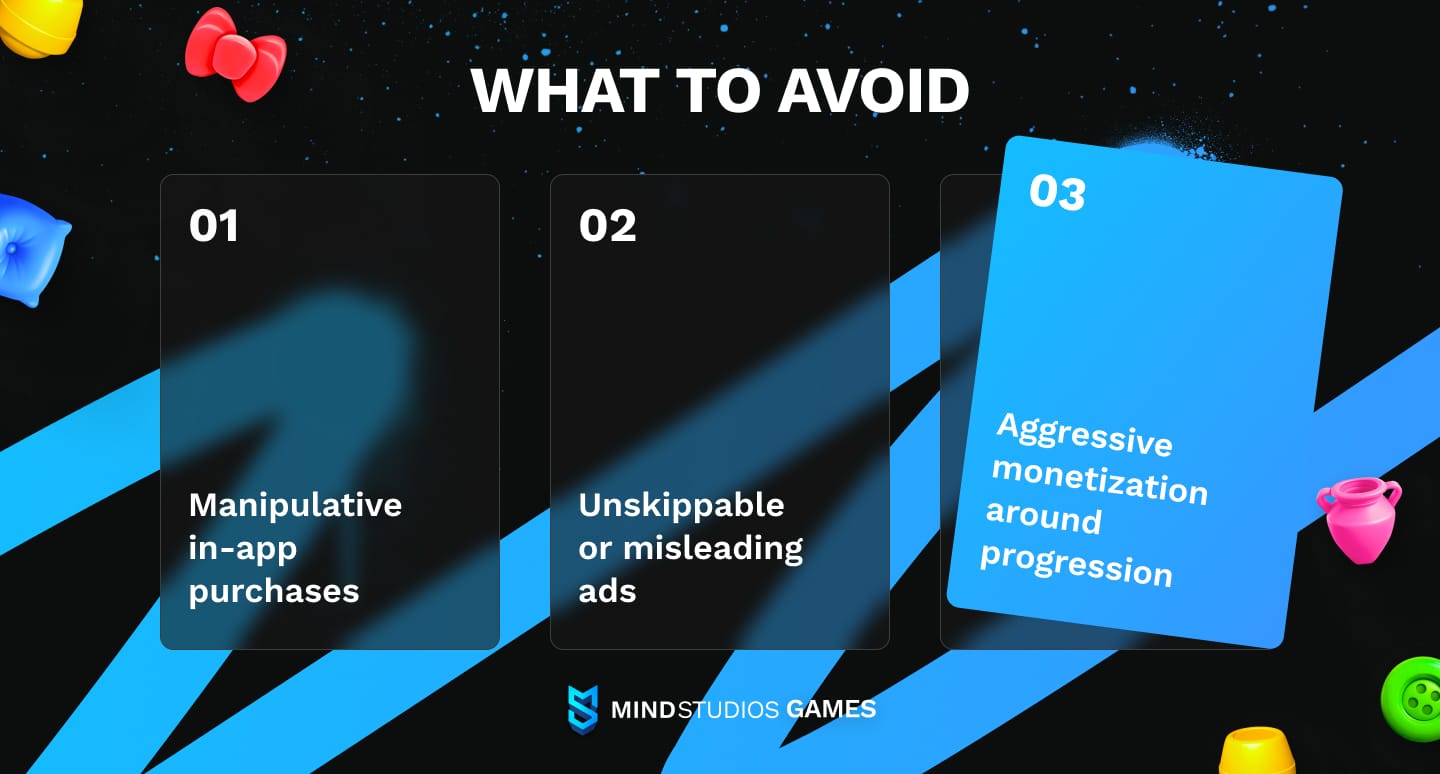
While ethical monetization builds community, exploitative methods can permanently damage a studio’s reputation, especially when targeting children. So what are the monetization models we would advise against? Here are the top-3.
#1 Manipulative in-app purchases
Tactics like timed offers, surprise boxes, or energy systems that pressure purchases fall under manipulative design. Regulators have been tightening the leash since 2023, with several regions requiring clearer disclosure of random-reward mechanics. But beyond legal risk, these tactics create frustration for parents and confusion for young players who don’t understand value exchange.
If microtransactions are used, they should be clear, optional, and fully explained in language suitable for both children and parents. Avoid psychological triggers that exploit limited comprehension, like countdowns and fear of missing out.
Transparency and parental consent are essential. Every transaction prompt should be clear, age-appropriate, and easily reversible.
#2 Unskippable or misleading ads
Gen Alpha is highly sensitive to interruptions, and parents name intrusive ads as their top frustration with children’s apps all the time. Unskippable or deceptive advertising undermines engagement and leads to immediate uninstall behavior.
Acceptable alternatives include rewarded ads that trade short attention for tangible, minor benefits (like extra coins or custom stickers). When clearly labeled and age-appropriate, rewarded ads can even reinforce the concept of exchange value without crossing ethical lines.
#3 Aggressive monetization around progression
Locking progression behind paywalls discourages persistence and contradicts the educational value parents often seek in Gen Alpha titles. Young players associate this practice with unfairness, which diminishes trust in both the game and the brand.
Instead of pay-to-progress systems, studios can:
- Offer optional “supporter packs” that accelerate cosmetic collection but not advancement.
- Use battle-pass models that reward playtime and effort rather than spending.
- Provide free-to-earn paths for all core gameplay content.
When progression feels equitable, children stay motivated — and parents remain comfortable allowing continued play.
Summary table: Recommended vs. not recommended monetization models
Recommended |
Not recommended |
|---|---|
Ad-free paid versions Build parental trust with transparent, one-time payment. |
Manipulative in-app purchases Exploit limited understanding and trigger frustration. |
Cosmetic-only microtransactions Encourage creativity and self-expression without imbalance. |
Unskippable or misleading ads Interrupt gameplay and erode engagement |
Subscription bundles Offer predictable, family-friendly recurring revenue. |
Aggressive pay-to-progress systems Undermine fairness and discourage sustained play |
Successful games for Gen Alpha
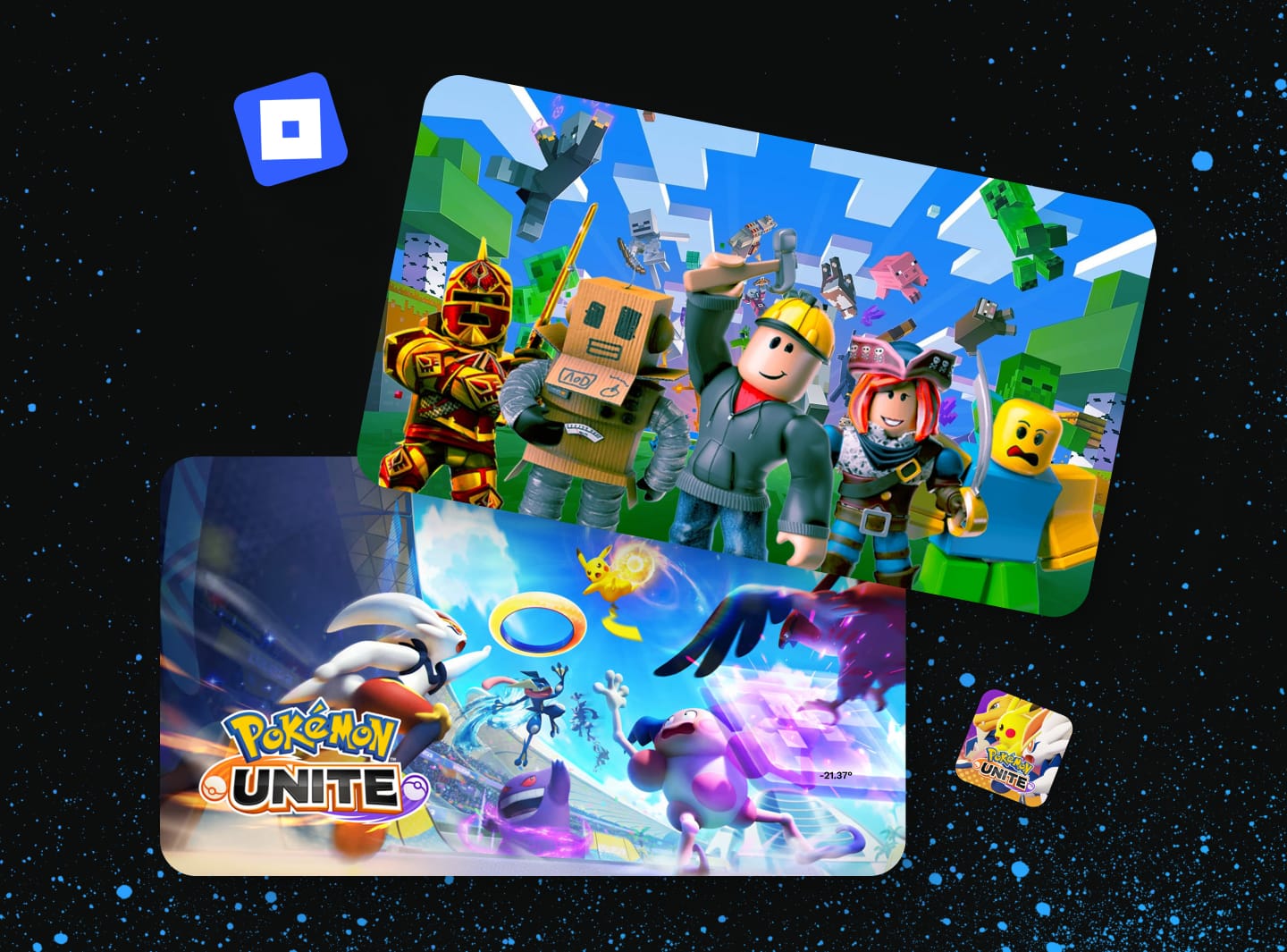
Analyzing top-performing Gen Alpha games helps identify what works — and why.
Pokémon Unite
Pokémon Unite, a multiplayer online battle arena (MOBA) by TiMi Studio Group and The Pokémon Company, blends fast-paced action with team-based cooperation. Matches typically last between 8 and 10 minutes, neatly fitting into Gen Alpha’s shorter play sessions.
Why it works for Gen Alpha:
- Accessible design. The controls are streamlined for mobile devices, using intuitive drag mechanics and large touch targets that are easy for children to master.
- Team collaboration. Co-op play encourages communication and social learning. Even when playing with strangers, the game’s emoji and preset message systems reduce the risk of inappropriate interaction.
- Visual feedback and motivation. Each match is filled with bright colors, progress bars, and celebratory effects that make achievements instantly visible.
- Fair monetization. Cosmetic-only purchases (outfits or arena themes) allow expression without influencing performance, satisfying both kids and parents.
Roblox
Roblox is less a game and more an ecosystem where users create and share their own experiences. With over 70 million daily active users as of mid-2025, a significant portion is aged 8–15 — the core of Gen Alpha.
Looking at a different angle, Roblox dominates the conversation about what games Gen Alpha play. Its open-ended nature empowers users to create their own games and share experiences.
Why it works for Gen Alpha:
- Creative empowerment. Roblox lets players design worlds, code interactions, and share projects with peers. This creative agency transforms players into creators, aligning perfectly with Gen Alpha’s desire for autonomy and imagination.
- Social ecosystem. Safe chat filters, friend lists, and moderated groups create a sense of belonging. Players collaborate naturally while maintaining parental oversight.
- Layered learning. By experimenting with Roblox Studio, children learn fundamental programming and design logic in a playful context.
- Flexible monetization. The platform’s Robux currency allows purchases across games, but strong parental controls and spending limits keep transactions transparent.
Conclusion
Gen Alpha is forcing studios to reevaluate their approach to game development: their expectations for creativity, instant gratification, and inclusivity are setting new standards. To succeed with this generation, developers need to:
- Focus on simple, visual UX and UI
- Use short, rewarding loops and gentle progression
- Offer safe social features and ethical monetization
- Embrace creativity and customization
In 2025, this generation is still children and teens. However, they differ from any generation before them more than ever. Designing for Gen Alpha is not just about making fun and safe games for kids — it’s about crafting positive, empowering, and creative digital experiences for the first fully mobile-native generation.
Ready to create a Gen Alpha-friendly mobile game and are looking for an experienced team to entrust this task? Contact Mind Studios Games to start designing your concept today. We also offer outstaffing and co-development services if you have a team of your own but need extra help or certain expertise.