
 ChatGPT
 Perplexity

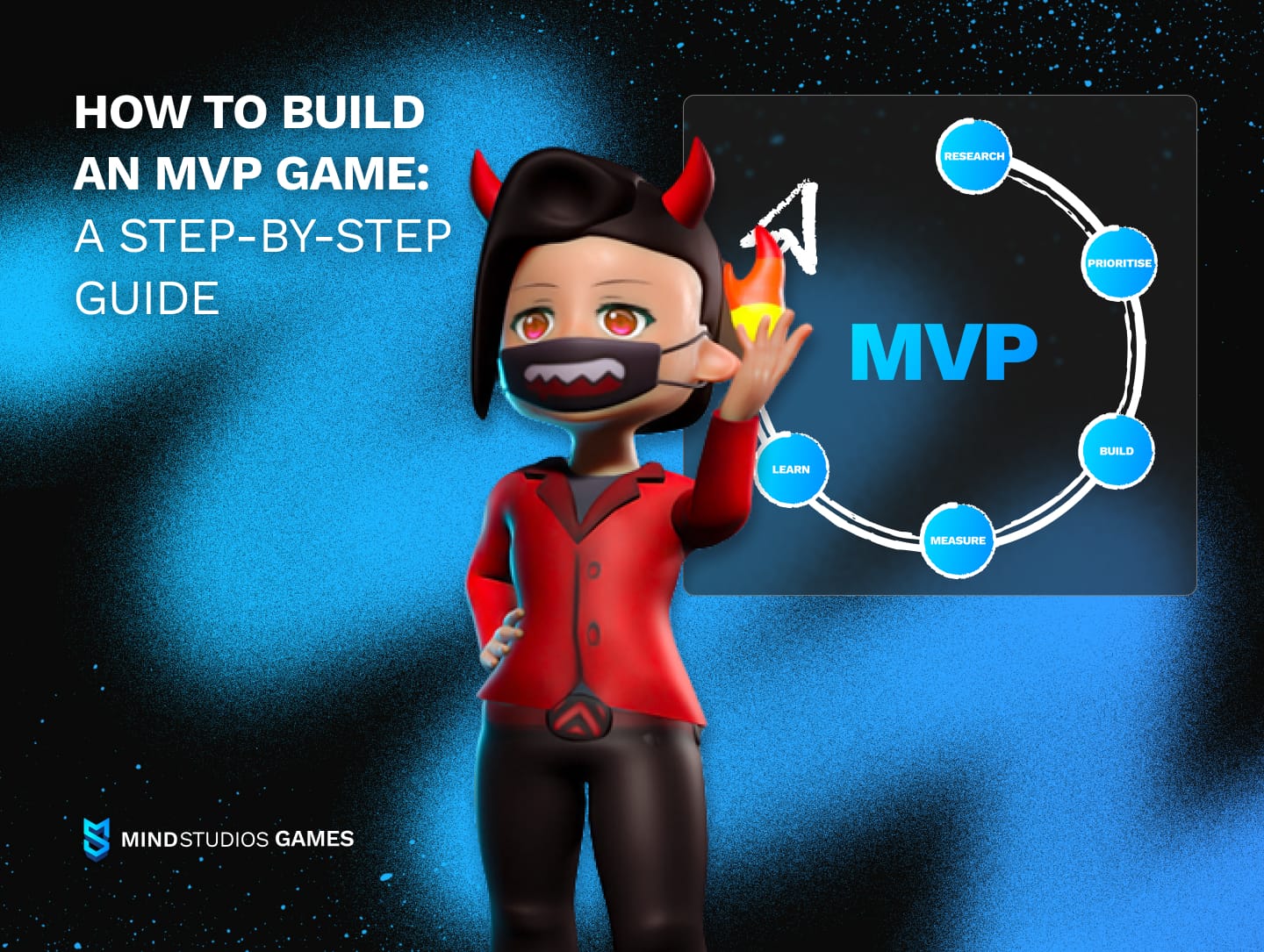
If you want to be smart about your budget, you might be interested in how to build an MVP game before the full version. Here’s a guide for that.
Highlights
- Building an MVP before the full game saves you time and money by helping you validate and prioritize features;
- An MVP is a good option for playtesting with real users, outside your immediate team;
- MVP is not a demo or vertical slice, though, so it’s not always the best option for pitching to investors.
In game development, a minimum viable product (MVP) is the simplest version of a game that still demonstrates its core loop and mechanics. It allows studios to validate ideas, attract investors, and collect real user feedback instead of investing months — or years — into full-scale production right off the bat. This approach helps reduce risks, streamline resources, and ensures you’re building a game people actually want to play.
Although mobile gaming remains a massive market, global consumer spending in 2023 fell to about US$107.3 billion, and downloads dropped to ~88 billion. Many regions have shown recovery in 2024, but competition remains high. This makes validating ideas with an MVP before scaling even more important.
In this guide, we’ll cover the benefits of MVP game development and talk about how to build a minimum viable product game, from defining scope, the step-by-step process, common pitfalls, and to answering some questions we’ve heard from our clients throughout the years. And if you have more questions after reading, or if you’re already looking to turn your idea into a tested MVP game, contact our team for a consultation and a rough estimate.
Benefits of MVP game development
In 2024, indie games generated nearly 48% of total full game revenue on Steam, proving that smaller, well-scoped projects can succeed alongside big-budget releases. But to do that, they need to be validated early and targeted effectively. And that’s the main goal of MVP game development.
Building an MVP game isn’t just about speed — it’s about making smart, data-based decisions early in the development process. Let us show you a breakdown of the key advantages:
| Benefit | Why it matters |
|---|---|
| Fast validation of the core loop | The MVP lets you test the central gameplay mechanic quickly to see if it resonates with players. If the loop isn’t engaging, you’ll know early and can adjust direction before investing heavily. |
| Early user feedback | Releasing an MVP to a controlled group of players enables you to collect feedback from a real audience before scaling. This feedback highlights friction points, helps refine mechanics, and ensures you’re designing around player expectations. |
| Lower development costs | By focusing only on essentials, you avoid wasting resources on features that may never be used. As a result, development budgets become smaller, reducing financial risk while keeping flexibility for iteration. |
| Attracting funding and early adopters | You can use the MVP for pitching your idea: investors and publishers are more likely to support projects that show tangible proof of concept. Plus, an MVP that went through playtesting or alpha release demonstrates traction with real players, making it easier to secure funding or build an early fan base. |
| Avoiding feature creep | Large projects often suffer from bloated feature sets that delay launches and drain resources. MVP development keeps scope tight and ensures every feature supports the core gameplay purpose. |
How to define your MVP scope
The key to creating an MVP game lies in choosing the smallest scope that can still validate your idea. Here’s a short “how to” for approaching it:
- Identify your core gameplay loop. What is the repeatable mechanic players will engage with most?
- Define the minimum feature set. Prioritize features that support testing this loop only.
- Set must-haves vs. nice-to-haves. Movement/UI = must-have; advanced customization can wait.
- Choose launch platforms. While most game engines are cross-platform, it’s still essential to decide if you’ll release on mobile, PC, console, or web, based on your audience. You’ll need to take into account platform differences when working on game UI/UX and working out resource-intensiveness required to run your game.
- Decide on the timeline of development. A reasonable MVP timeline is 3–6 months, depending on complexity, but it’s best to carefully examine everything with a professional team, so that you don’t rush too much yet don’t miss the window of opportunity created by trends.
❗️ Mind Studios Games’ tip: Write a “not-in-MVP” list to avoid scope creep.
MVP game development process in 8 essential steps
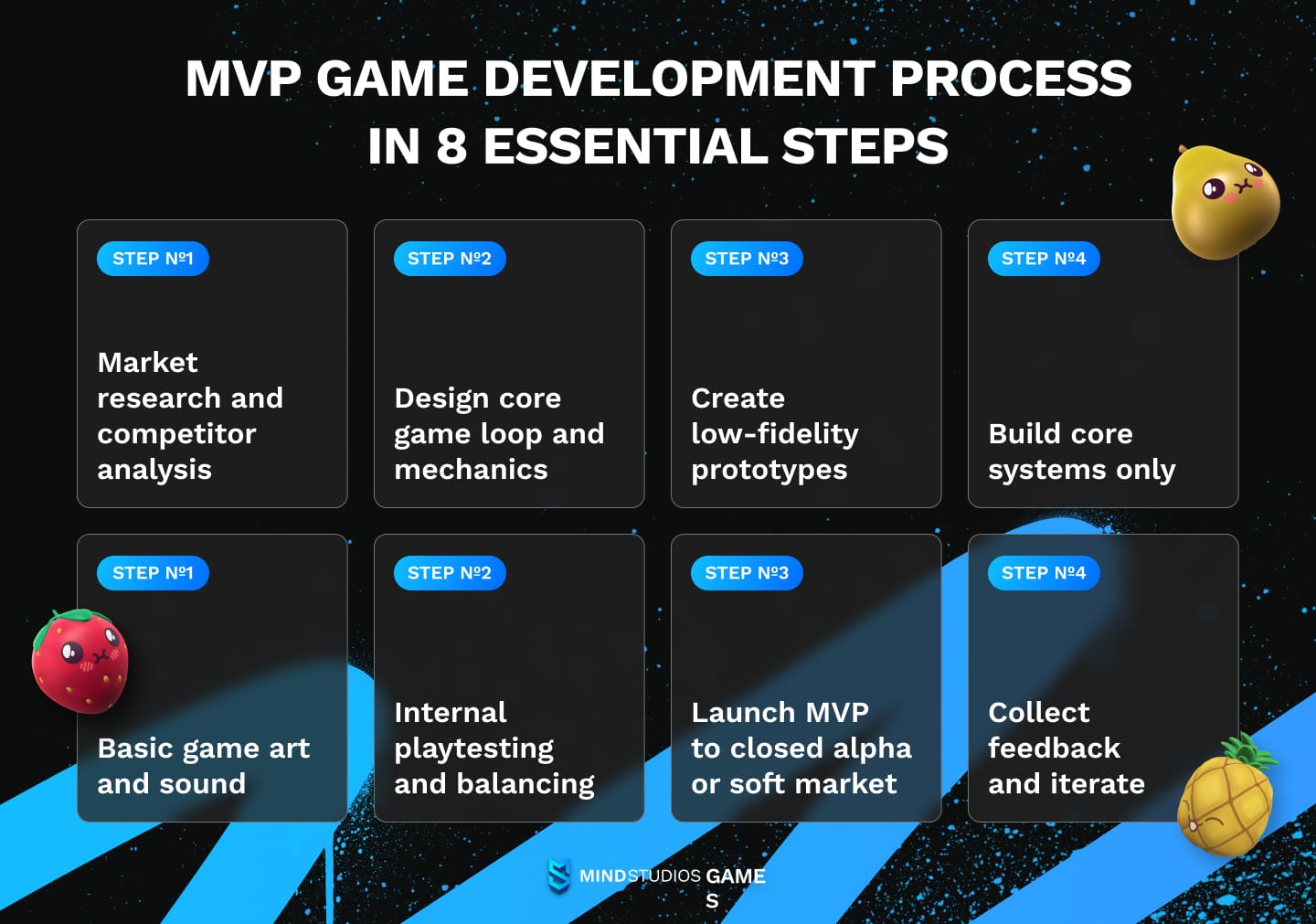
Step #1 — Market research and competitor analysis
Before writing a single line of code, it’s essential to understand the market. Research current trends, target audiences, and monetization models to identify what resonates with players.
Competitor analysis helps uncover both oversaturated areas and potential gaps where your game can stand out.
A structured market audit also prevents building an MVP that simply replicates existing titles. By focusing on underserved niches or mechanics, you increase the likelihood of validating something players truly want.
Step #2 — Design core game loop and mechanics
The core loop is the foundation of your game — it defines what players will repeatedly do and why they’ll keep coming back. During this stage, you should document and visualize the cycle of actions, rewards, and progression that forms the foundation of gameplay.
Keeping the loop simple ensures that it’s easy to test and refine. Complexity can always be layered in later, but if the loop isn’t compelling at its most basic, additional features won’t fix the problem.
Step #3 — Create low-fidelity prototypes
Prototypes allow you to test ideas quickly without investing in expensive assets. These can be paper sketches, click-through mockups, or lightweight digital builds created with prototyping tools.
The goal here is not polish but validation. A rough prototype can answer critical questions: Does the mechanic make sense? Is it fun? Does it communicate the intended experience? Early answers save weeks of costly development.
❗️Mind Studios Games’ tip: You can make a very basic prototype without engaging actual developers — via vibe coding with an AI algorithm. About a third of our clients in the last half a year came to us with a vibe-coded prototype, and it made understanding the project easier.
Step #4 — Build core systems only
At this stage, focus solely on implementing the essential mechanics that bring your core loop to life. This might include movement, combat, scoring, or interaction systems — whatever is critical to the gameplay test.
Avoid building advanced progression systems, customization, or extra layers of UI. Limiting scope helps deliver a functional, testable product faster while preventing wasted effort on features that may be cut later.
Step #5 — Basic game art and sound
MVP game art and sound should serve a functional role rather than aim for visual perfection. Placeholder assets or simplified designs are usually enough to communicate the game’s style and tone.
Audio, even in its simplest form, plays an important role in feedback loops. Basic game sound effects for actions like scoring, attacking, or winning can significantly improve the playtest experience without heavy investment.
Step #6 — Internal playtesting and balancing
Before releasing the MVP externally, conduct extensive internal testing with your team. This helps catch critical bugs, balance issues, and usability problems early. Even small tweaks to controls or timing can drastically improve gameplay flow.
Balancing at this stage is less about final tuning and more about making the MVP enjoyable and understandable. A game that feels broken internally won’t provide useful feedback when tested externally.
Step #7 — Launch MVP to closed alpha or soft market
Once the MVP is stable, share it with a small group of real users. This might take the form of a closed alpha / playtesting with invited users or a soft launch in a limited region. Both methods provide valuable, low-risk exposure.
Early external testing ensures you collect genuine user feedback and data from people outside the development team. This stage validates whether your target audience responds to the core loop as expected.
❗️Mind Studios Games’ tip: Research suggests that games staying in early access for about 6 months (an optimal window is between 4–9 months) achieve stronger player growth after full launch. Part of it is due to built-up anticipation, and another to time spent polishing the game based on real player feedback. Longer periods often weaken momentum, though, so you need to be careful.
Step #8 — Collect feedback and iterate
Gather structured feedback through surveys, interviews, and in-game analytics. Analytics, in particular, are crucial because they reveal behavior patterns that players may not mention directly. Metrics like retention, session length, and drop-off points guide refinement.
Iteration is the core of MVP development. Each testing cycle should focus on adjusting mechanics based on data until you confirm the loop is fun, intuitive, and engaging. Only then should you consider scaling the project.
❗️Mind Studios Games’ recommendation: Build analytics in from the start. Tracking player behavior helps identify friction points that feedback alone might miss.
What to include in an MVP game
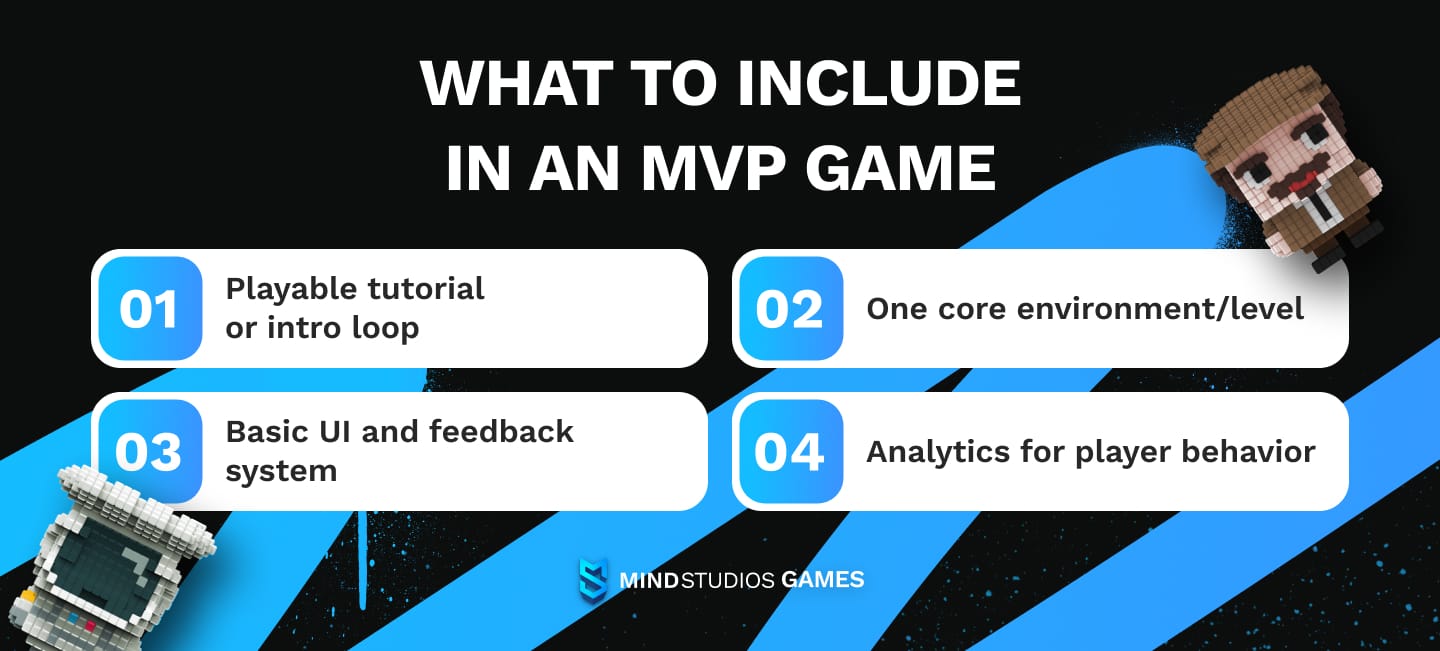
There’s no too many repetitions to this: The optimal approach to developing a game MVP includes only the essentials. Each element serves to validate gameplay, not to deliver a polished final product. Here’s what you need, no more and no less:
- Playable tutorial or intro loop. A short introduction helps players understand controls and objectives quickly. It reduces friction and ensures feedback focuses on gameplay rather than confusion.
- One core environment/level. Limiting the MVP to a single space keeps scope lean while still allowing you to test pacing, flow, and player engagement.
- Basic UI and feedback system. Simple menus, heads-up displays, or progress indicators guide the player and confirm that actions are registering as intended.
- Analytics for player behavior. Tracking data such as playtime, retries, or abandonment points reveals valuable insights into how players interact with the game.
Do not include full game art pipelines, multiple advanced levels, rich narrative arcs, or live-service features. Not at this development stage, it will only prolong the development, eat at your budget, and may end up being futile.
If you really want to add something more, a simple monetization or game leaderboard system would be a better choice, especially if it’s part of your long-term vision; a minimal implementation allows you to test user response to rewards, competition, or spending.
Common mistakes to avoid
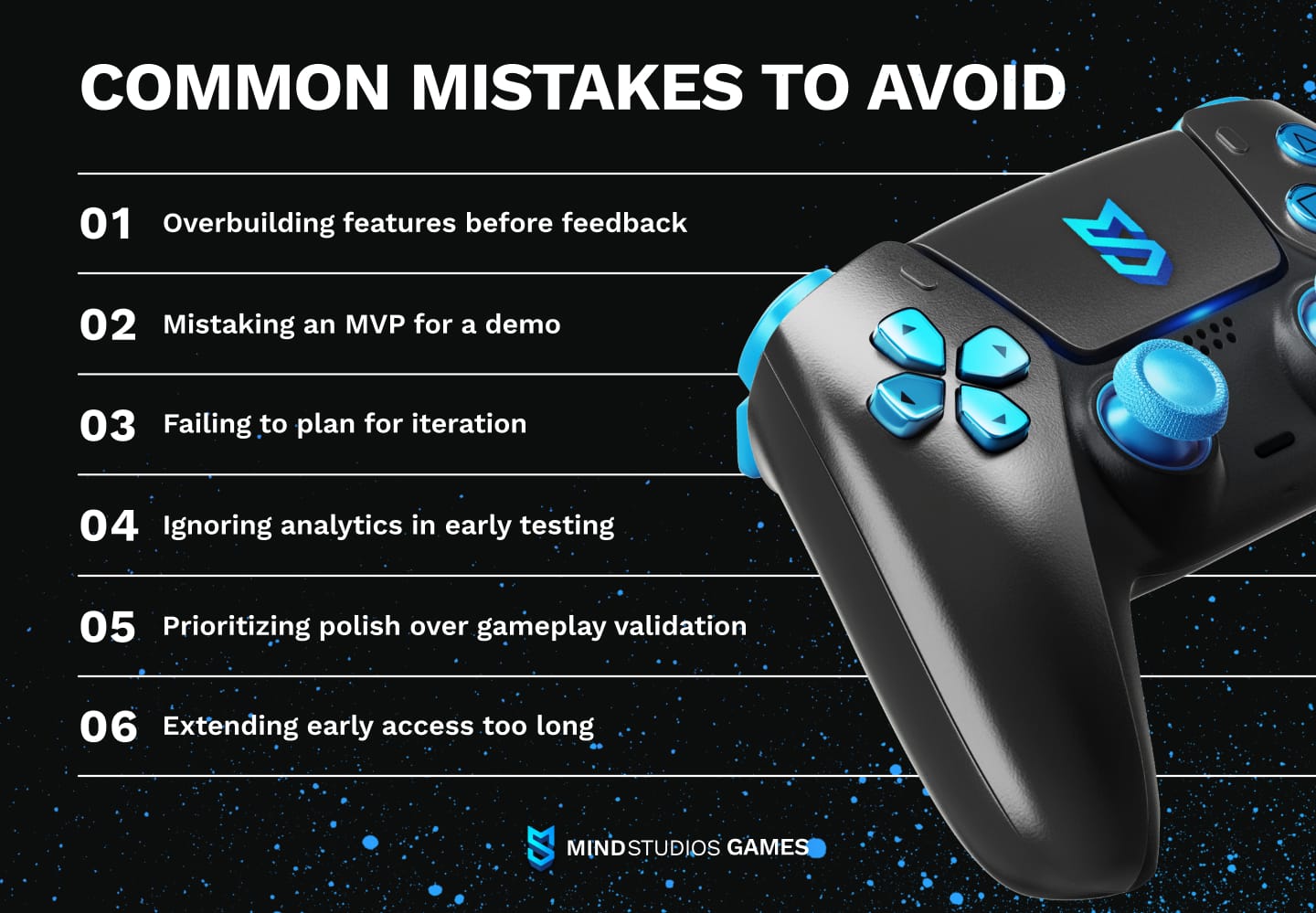
To finish off this article, let’s talk about possible pitfalls. After all, there are quite a few, and you’re putting time, effort, and money into this.
Even with a clear plan, MVP development can go off track. Below are the most frequent mistakes teams make when building a minimum viable product game, and why they should be avoided.
Overbuilding features before feedback
One of the biggest pitfalls is adding too many features before testing the core loop. This not only delays the MVP release but also wastes resources on mechanics that may never survive iteration. An MVP’s purpose is to validate assumptions, not deliver a full game. Keeping scope minimal ensures you learn fast and pivot when needed.
What to do:
Keep to your list of must-have features, and don’t be tempted with nice-to-haves unless data and feedback show they would really add to the game’s attractiveness.
Mistaking an MVP for a demo
Many developers confuse an MVP with a demo, but they serve different purposes. A demo is designed to showcase a polished vertical slice for marketing or fundraising, while an MVP is a functional test of the gameplay loop. Prioritizing polish too early often hides the real issues with engagement and mechanics.
Failing to plan for iteration
An MVP is not a one-off build; it’s part of a cycle of testing and improvement. Teams that don’t plan for iteration risk treating feedback as an afterthought, which reduces the value of the MVP.
What to do:
Set aside time and resources for multiple feedback loops beforehand, so you can refine mechanics and make data-driven decisions. Iteration is where MVPs provide the most insight.
Ignoring analytics
Player surveys and opinions are useful, but they can be subjective. Without analytics, you miss hard data about how people actually interact with your game. Tracking metrics like retention, session length, and points of frustration helps you identify problems that players may not articulate. Strong analytics at the MVP stage give you a clearer foundation for scaling.
Prioritizing polish over gameplay validation
Beautiful visuals and detailed narratives may impress on the surface, but they won’t matter if the core loop isn’t engaging. Some teams invest heavily in graphics and content, only to discover that players don’t enjoy the mechanics.
What to do:
Fun always comes before finish in games. Focus first on gameplay validation, and do it intentionally. This way, you will avoid spending money and time polishing features that might not survive to full release.
Extending early access too long
A final mistake is leaving an MVP or early access build live for too long. Research we already mentioned shows that games staying in early access beyond 9 months often see weaker growth after full release. Long testing cycles can drain momentum and exhaust player interest.
What to do:
Quite obviously, aim for shorter, focused iterations to keep feedback actionable and excitement alive.
Conclusion
An MVP is not a stripped-down demo — it’s a strategic tool to test, validate, and refine your core game loop before committing to large-scale development. By starting lean, you minimize risks, attract funding, and build confidence in your game’s future.
With the market oversaturated like it is now, it’s ever important to not splurge on fancy, flashy game art before you know for sure players will want to stay in your game. Validate first, then iterate — and you will obtain a perfectly marketable game that will bring you success.
Need help developing a game MVP? Contact Mind Studios Games to scope, design, and build your MVP with a seasoned development partner. Or you can talk directly to our Head of Gamedev on LinkedIn! We hope to hear from you soon 🙂