
 ChatGPT
 Perplexity

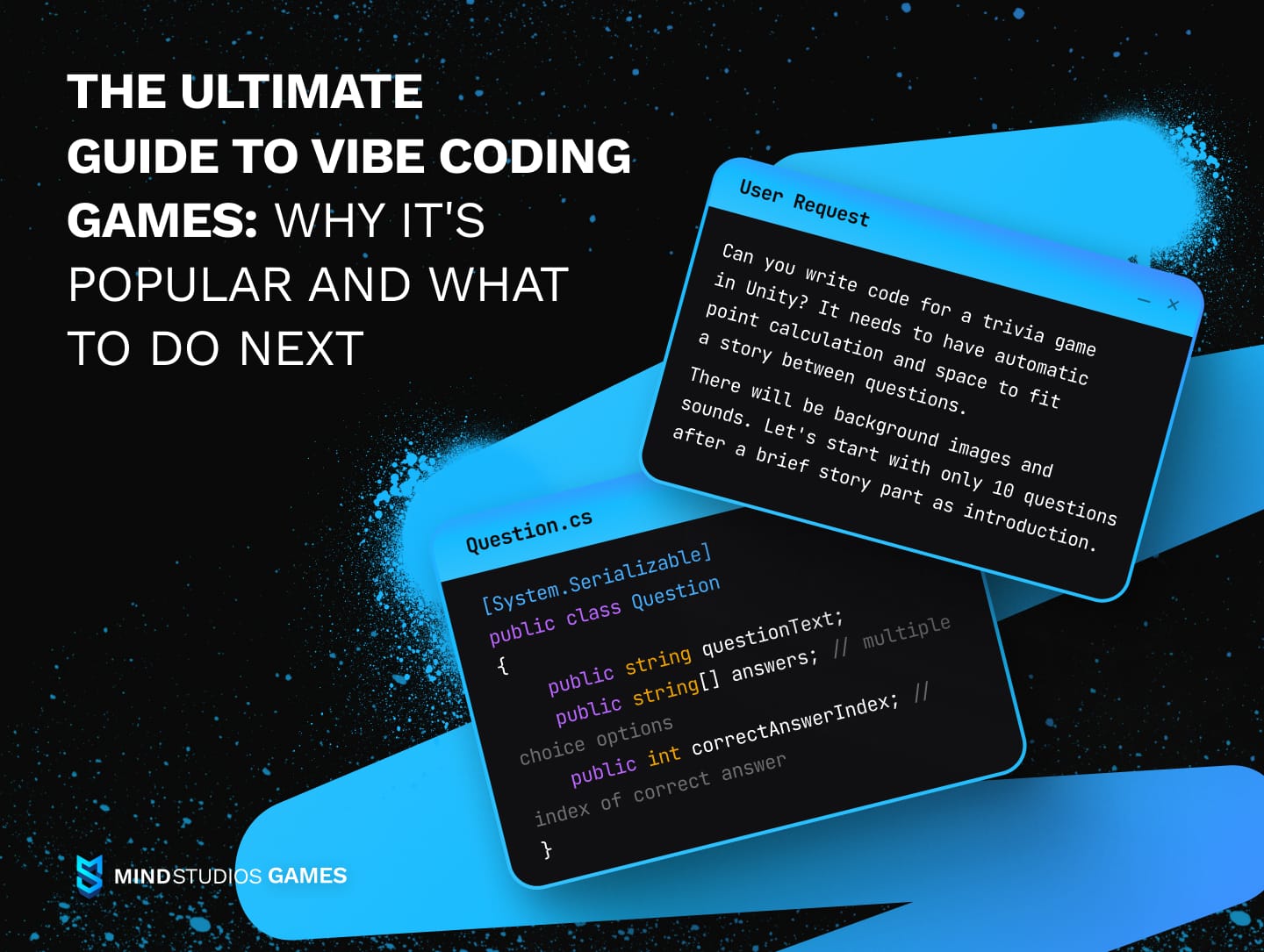
Interested to know what that “vibe coding games” thing is and how to do it? Read our article to get some insights.
Key takeaways:
- The huge leaps in advancement of AI make coding more accessible, and vibe coding is the buzzword of 2025 in software development, including games;
- Vibe coding can be a great tool for prototyping or building very basic games as a hobby;
- However, vibe coding can’t replace human developers just yet, as there are sizable complications and drawbacks to AI-generated software code.
Software development in general and game development in particular are notorious for their complexity — coding is no joke, after all. Even to create a simple game, or a prototype to test waters, one needs to either study for a while, or spend a pretty penny to hire a team for game development.
Well, it seems that particular struggle is no more — thanks to the phenomenon we call “vibe coding”. What is it and how it works? Let us tell you!
This article will explore the peculiarities of vibe coding, where it’s best applied, and what you’ll need to be on the lookout for if you decide that vibe coding video games is the way you want to go.
What does vibe coding mean?
Let’s start with the vibe coding definition. As Andrej Karpathy, the person who coined the term, puts it,
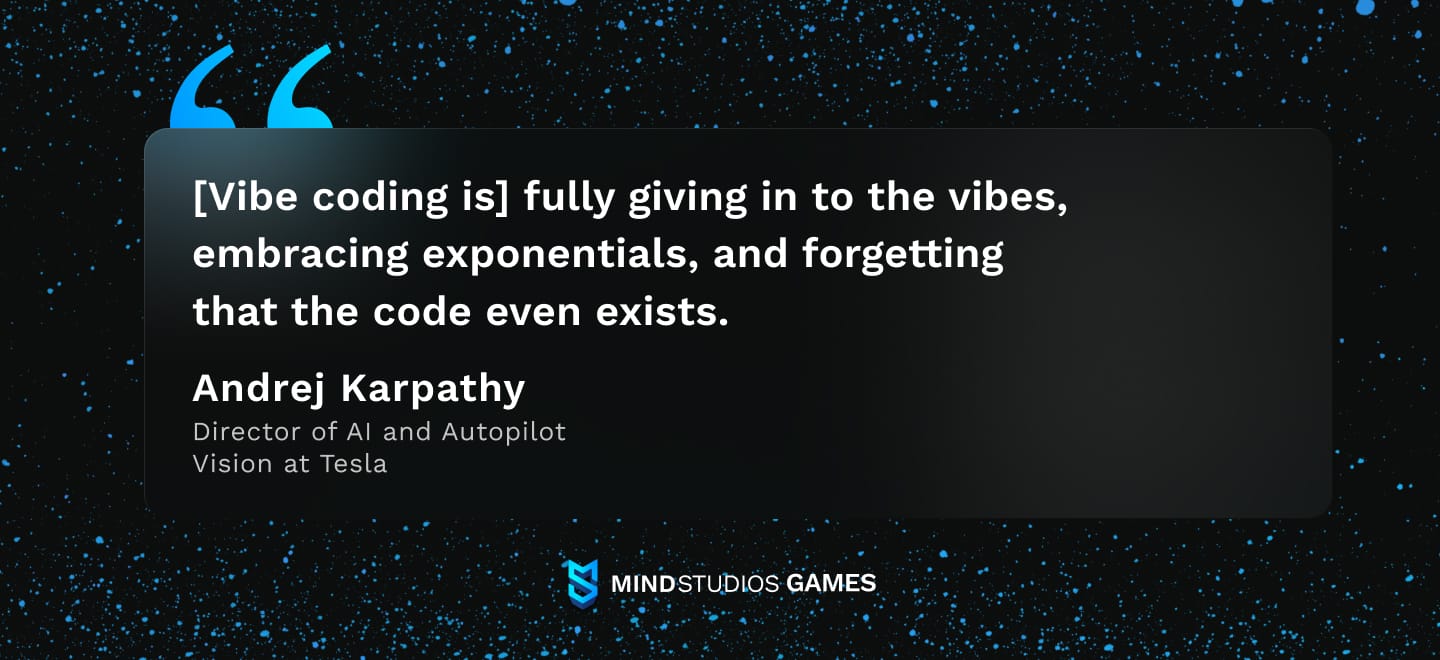
Sounds very vibe-y, doesn’t it? Well, in its essence, vibe coding is a casual approach to building software possible with surface knowledge of coding at most, or even none at all. Basically, it’s describing your game idea to an LLM and asking it to generate code for you.
In a way, it might seem similar to AI-assisted coding, but it’s not entirely the same. With AI-assisted coding, whether they use LLMs to generate the base code and then check it and build upon it, or they use chatbots to check and fix code mistakes, developers still need professional coding knowledge.
In vibe coding, on the other hand, it’s completely up to the algorithm to whip up code, from start to finish. The developer’s job is to load it into the compiler and see if it works, and if it doesn’t, or there are bugs — to ask the LLM to check it and fix it. Rinse and repeat until you get satisfactory results.
Why is vibe coding so popular now?
The answer to that question is pretty simple. There’s no reason for something to not become popular if it makes you a developer without you having to go through months or even years of studying. It’s like lucking out and winning a race thanks to wind pushing you to go faster.
But jokes aside, what are the main benefits of using vibe coding? Because there are several.
| Reasons for vibe coding popularity | |
|---|---|
| Accessibility | Almost anyone can vibe code a simple app or game, all you need is an idea and an ability to explain it in enough detail for a computer to understand. You can refine the results in iterations until everything is the way you want it. |
| Speed | Even the simplest game takes hours, days, or weeks to code by a developer, depending on their skill level. An LLM will give you the code within seconds, and even with multiple iterations, it will be faster than a human. |
| Trend on short simple games | At the point we’re currently in (in terms of AI and LLM development), you can’t cheat yourself into vibe coding video games like, say, The Witcher franchise. However, Gen Z and Gen Alpha, for example, are very much into short-form games, simple mechanics, and mindless repetitiveness — due in part to the constant information overload the globalized world creates. And these types of games often can be built “on a vibe”. |
| Games as a marketing tool | Non-gaming brands are using games to attract new audience — especially younger generations — all the time. Most of those games are temporary, or extremely basic in mechanics and meta. Building your own game by vibe coding is faster and cheaper than employing experienced professionals. |
| Use in game prototyping and idea validation | Even seasoned developers often agree that vibe coding games can be helpful — not as a replacement for proper coding but to do some basic prototyping. It allows us to look at the game from new sides, refine the design, see the direction for development — and do it fast. Moreover, this level of prototypes can be used to pitch your game to investors. |
Overall, we’d say vibe coding is quite the logical next step after AI-assisted coding — further simplified, but with its uses.
The challenges in vibe coding games
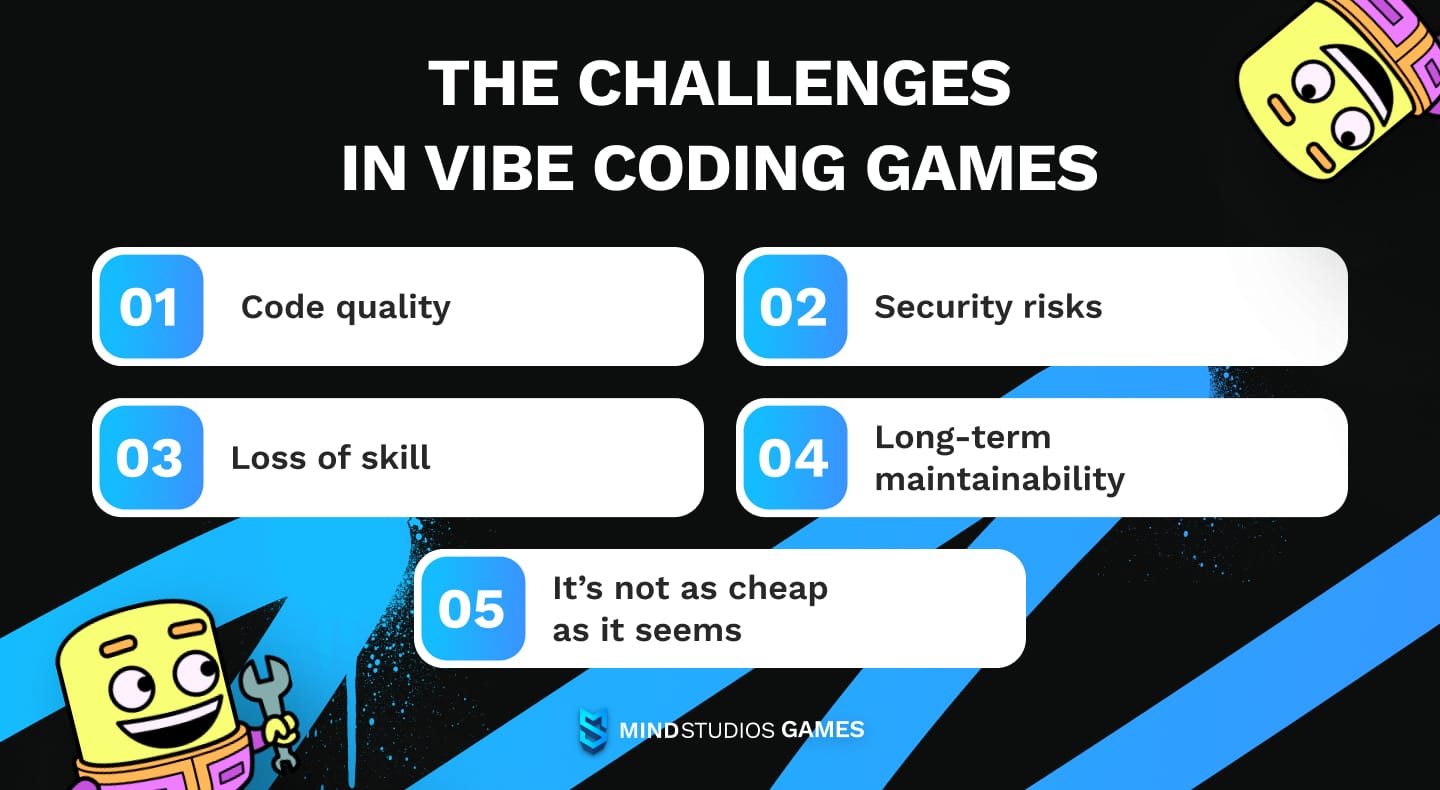
Of course, the approach is far from perfect — as most things GenAI are, at this point in time. Here are some arguments against vibe coding, or rather, for using vibe coding for games only in certain ways.
#1 Code quality
Generative AI tends to be inconsistent, at best, and outright incorrect at worst. That is true for treating it as one of the vibe coding tools as well. To get quality results from it, you’ll most likely need multiple iterations — and we’re not talking two to five, but probably dozens. LLMs also can’t handle edge cases, which is essential for a game developer who’s in it for success and not just for kicks and giggles.
#2 Security risks
This might matter little for prototyping or if you’re making a game purely for fun, but AI models do have a tendency to miss security steps in code, unless explicitly prompted. What it means in practice is, if your game happens to require user data for anything — sign-up, IAPs, etc. — with vibe coding alone that data might be vulnerable. And that will cost you players and, potentially, penalties.
#3 Loss of skill
For professional coders, overly relying on AI and/or getting complacent with its results can lead to losing the grasp on code details. For those just starting to code, likewise, AI, while speeding up the game development, can slow down the learning process.
It might seem like an issue of little importance — until mistakes start popping up in the AI-generated code, and programmers can’t fix them because they don’t know enough about it.
#4 Long-term maintainability
LLM code is, at the current level of AI, clunky and difficult to debug. As one of our developers called it, “a spaghetti monster”. This poses a huge challenge to game developers, since games, especially mobile ones, rely heavily on scaling — things like LiveOps and frequent updates. Each new update needs to fit seamlessly into the existing code and not cause disruption or bugs, which is virtually impossible to achieve by vibe coding games.
#5 It’s not as cheap as it seems
As LLMs gain popularity, their prices go up exponentially. One might say, it’s still not as expensive as hiring an actual developer! Well, yes, that might be true, at least for not. But there’s a caveat. As our senior Unity developer puts it,
“In the end, you’ll need to hire a highly skilled developer to go over everything the AI might have missed, and that will cost you. Ask any seasoned developer, and they’ll tell you that fixing someone (or something) else’s code is more tedious and often takes more time than coding the same thing from scratch.”
— Dmytro, senior developer at Mind Studios Games
Tips for building your own game
As you probably understood, "vibe coding" isn’t a formal industry term but rather a creative development mindset. Think of it as designing and building in flow, where rapid iteration and experimentation potentially lead to better player experiences. The emphasis here is on fast feedback loops, mood-driven creativity, and low-friction prototyping.
So how can you organize the process?
Steps |
Explanation |
|---|---|
1. Decide on the “feel” of your game |
Players more often remember how a game feels than its mechanics. So start with what you want players to feel when playing your game. |
2. Break down your game into parts |
This can be features, for example. By making the algorithm focus on small bites, you avoid clutter. You’ll still need to compile all the code bits into one system, which will be a struggle on its own, but at the very least, you’ll avoid clutter and bring down the number of inconsistencies. |
3. Make a highly detailed description of what you want to create |
LLMs work best with exhaustive descriptions of what you need them to generate. Vague prompts will result in unworkable, tangled spaghetti code, ripe with security gaps and bugs. Building a working game from that will require lengthy refinement, which means a lot of time and money. |
4. Test every scenario multiple times |
Because the code quality of LLM-backed vibe coding is generally not very high, you should test and retest the code it gives you. Document all that happens to apply at the next stage. |
5. Iterate without perfecting |
If you’re a professional coder, you will be tempted to “fix” the AI-generated code right away. But instead of spending time doing that, ask the algorithm to fix things you discovered to be wrong. Rapid iteration is at the heart of vibe coding games, and the reason it even came into existence. |
6. Arm yourself with plenty of patience |
As we already stated before, vibe coding for games, same with any other types of apps, will take multiple iterations to come up with anything that actually works. Keep that in mind when you decide to vibe code your idea. |
With all that in mind, what tools help in vibe coding video games?
Nowadays, everyone and their great-aunt add AI to their services in one way or another. But AI assistance like Upscaler plugin in Figma is one thing, and making a whole new game — even at prototype level — is another. Here’s a short list of useful vibe coding tools we know of.
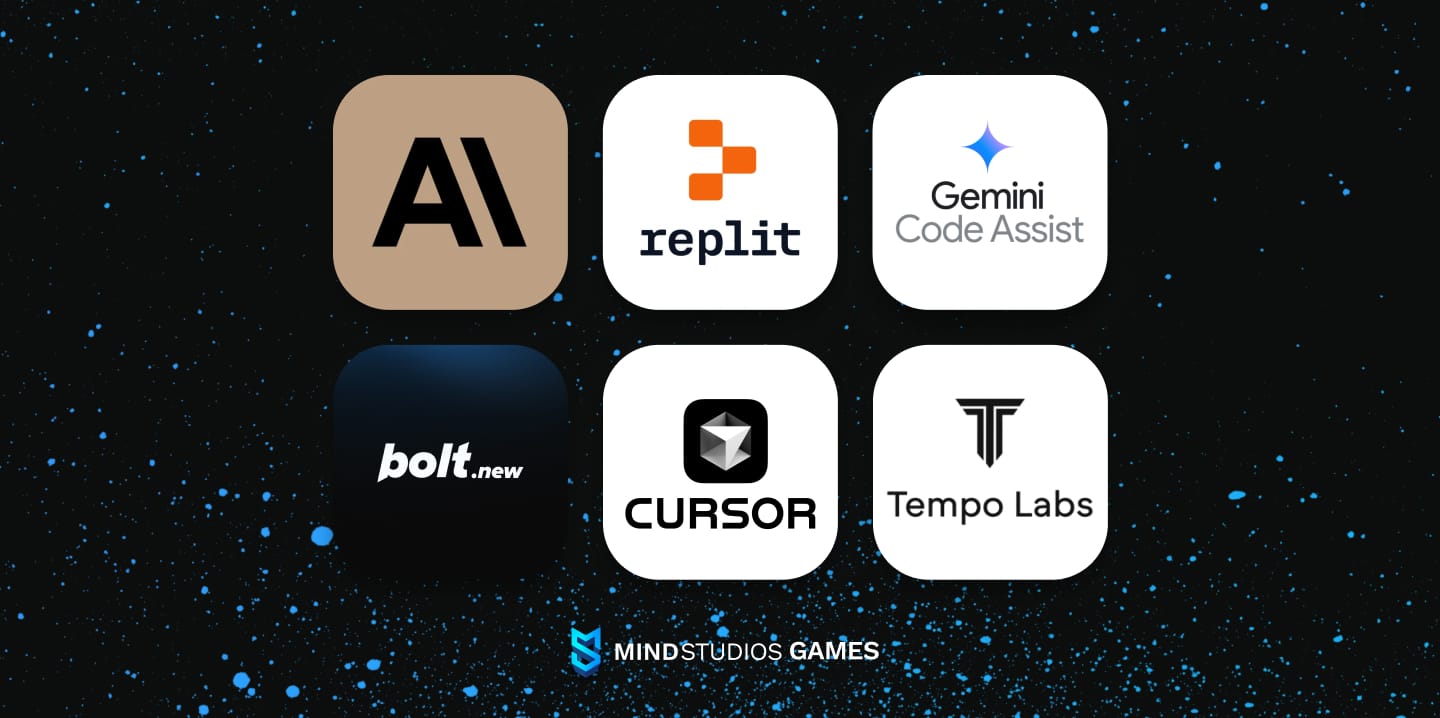
- Claude Code by Anthropic. A terminal-based tool that reads your codebase, maintains memory across sessions, and excels in task automation. However, it’s resource-intensive and costly.
- Replit. A browser-native environment that allows complete non-technical users to generate entire projects through prompts. Supports gradual learning (called the “hybrid approach”) and includes real-time previews and debugging tools, although the latter have quite the learning curve.
- Gemini Code Assist. Enhances traditional IDEs (like VS Code) with AI-powered in-line code generation, improvements, and testing assistance.
- Bolt.new. Can handle everything from prompt to deployment, making the process ultra-simple for beginners and non-technical creators. On the downside, though, the code control and customization are very limited.
- Cursor. An AI-powered IDE that lets you refine and debug vibe-coded apps through chat-like interactions, including performance, accessibility, and security feedback. Particularly useful for those who want greater control after AI generation. Not for complete newbies, requires technical awareness.
- Tempo Labs. Great for error fixing, integrates with tools like Supabase, Figma, and VS Code. It’s forgiving on tokens, making vibe coding less painful when prompts misfire. But it’s limited to React/Vite/Tailwind stack.
What to do next?
As we established in the earlier sections of this article — and most of the professional community agrees — vibe coding is a great option for prototyping, but building a fully marketable game with it is a decidedly no easy feat, be it time-wise or financially. So what should you do?
Well, when there’s something you have no skills to do on your own, it makes sense to hire a professional. As one such professional game development studio, we can certify that clients that come to us with a clearly defined project — and even better, a prototype! — are among those working with whom was the most effective and fast.
Before vibe coding games became possible, those prototypes could be Figma projects of UI, or a well-documented GDD, or a game made in a drag-and-drop game builder. Now, you can vibe code your game idea through an LLM, and it will be a workable prototype, but it will most likely need a professional still — at best, for checks; in many cases, for code reengineering.
If your choice to use vibe coding tools was made due to budget constraints, you can choose an outsourcing partner from countries with lower hourly rate yet good reputation quality-wise. Check Eastern Europe, for example — the rates are two and sometimes three times lower compared to US, but there are a number of companies that offer good portfolios in a variety of genres.
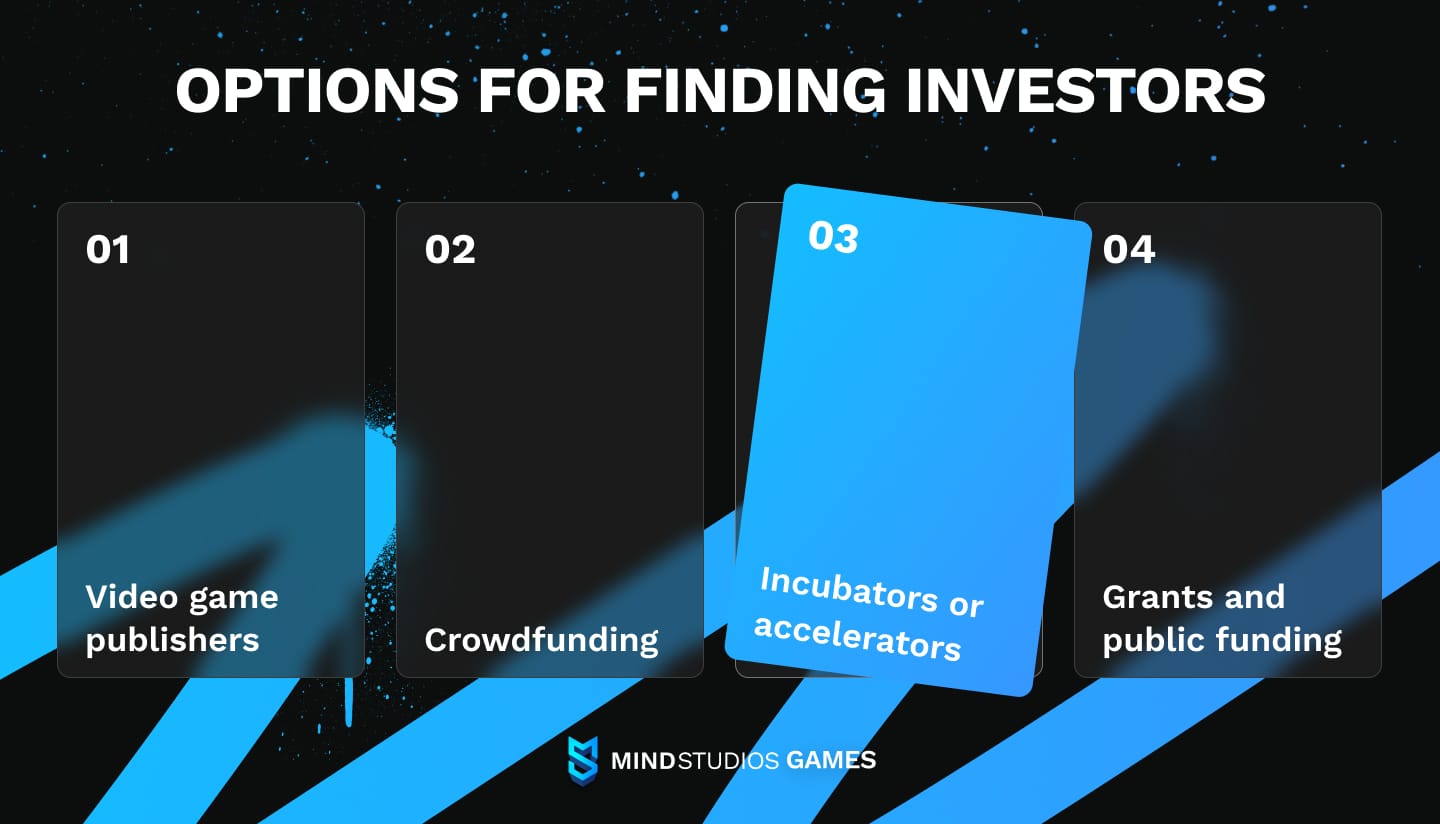
If you wish to fund your game externally, which is what many people with a game idea do, here are some options for finding investors.
- Video game publishers. A publishing deal can cover development costs and give access to marketing, QA, and distribution support. It’s a good way to start, as there are companies that specialize in partnering with small indie projects. However, you’ll need to offer them a share in your game’s future revenue, and you’ll also have competition.
- Crowdfunding. Platforms like Kickstarter or Indiegogo can raise funds while also proving your game’s appeal to an audience. You’ll need to do some marketing to attract a more enthusiastic crowd, and a prototype you’ve made via vibe coding your game will be a huge asset there. It will allow people to see that you’re serious about making it happen, and they’ll also be able to experience your idea in practice, offer feedback, etc. In a way, it’s a safer option than publishers, as you’re not exchanging your game’s future profits for investment. Instead, most Kickstarter projects provide backers incentives like early access, premium features/levels, cosmetics, etc.
- Incubators or accelerators. There are programs that provide funding, mentorship, and industry connections. Getting into one of them can be challenging, though, and winning is even more so, as the competition will be high. Again, vibe coding games to have a working prototype will be quite useful.
- Grants and public funding. Arts councils, cultural programs, or government-backed funds sometimes support indie developers without taking equity. A good option if your game can benefit your city (for example, it’s an educational game, or promotes your city/country with its content).
Conclusion
Vibe coding games is the new shiny thing, but as anything new in the tech field, it is for now a path riddled with uncertainty. Issues with security, "spaghetti code" and long-term maintainability, and costs in the long run make it unreliable for medium- and large-scale game development.
Vibe coding tools are, however, a decent practice opportunity for those just learning to code, and a good affordable option for prototyping before approaching a development team or a possible early-stage investor. After all, anyone can tell how much easier it is to reach understanding when there are visuals you can interact with.
We hope this article was useful to you and will encourage you to try new things, but to be careful about them. And when you're at the stage where you are looking to turn your vibe-coded prototype into a full game, remember to reach out to Mind Studios Games. With our experience in multiple game types and genres, from idle games to shooters, puzzles to management games, we're sure to be of help. Get in touch via our contact form below, or message directly to our Head of Gamedev on LinkedIn.